

Easter Getaways – Sand and Snow
By Marina Zeelie
Spring is arriving fashionably late this year. In 2026, Easter Sunday falls on 5 April — that delicious in-between moment when Europe’s highest mountains are still wrapped in winter white, while the Mediterranean begins to shimmer with the first serious promise of summer. With Dubai and much of the Gulf effectively off the spring escape list because of the ongoing conflict, attention is turning back to Europe in force. And so the Easter question feels sharper than usual: do you steal one last week of snow, or step early into sun?
The answer, as ever, depends on your appetite. For some, Easter belongs to bright alpine mornings, long piste lunches and sun on snow. For others, it should smell of salt, citrus and warm stone. And for the cleverest travellers of all, this is the rare week when Europe still allows both.
The last great ski window
Easter sits right on the edge of the European ski season. By early April, many lower resorts are already winding down, but the high-altitude names — the ones that matter — are still very much in play. This is the moment for the snow-sure addresses: Val Thorens, Tignes, Zermatt, Sölden and, most intriguingly of all, Sierra Nevada.
The secret is altitude. Above roughly 2,000 metres, spring skiing can still be glorious: crisp mornings, forgiving snow later in the day, and terraces that feel like a reward in themselves. The best Easter resorts are not simply open, but beautifully placed for the season. Val Thorens and Tignes remain among the strongest choices in France, while Zermatt’s glacier-backed slopes and Sölden’s high terrain keep conditions reliable well into April.
And then there is Sierra Nevada, that great Andalusian contradiction: a serious ski resort under southern skies, where snow and sunlight exist in almost indecent harmony. It is Europe’s southernmost major ski area, and at Easter it is often one of the most seductive.
What spring skiing feels like
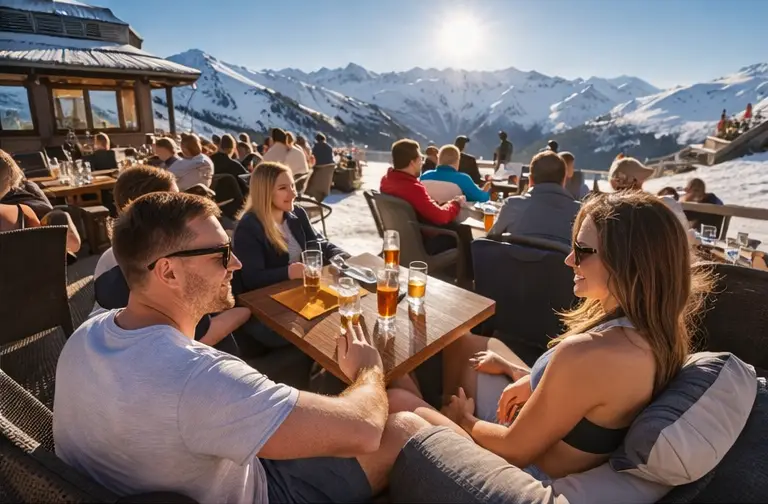
There is a particular glamour to skiing in April. The days stretch. The light softens. Heavy winter layers begin to give way to lighter jackets, mirrored sunglasses and that unmistakable end-of-season mood. Easter skiing is less about battling winter and more about enjoying its final, showy flourish.
The rhythm changes too. Early mornings matter more. This is when the pistes are at their best — firm, polished and fast. By lunch, lower slopes may begin to soften, and by mid-afternoon the day often belongs to terraces, champagne, oysters, long lunches or simply basking in the sunshine with ski boots unlaced.
If February is the month of earnest skiing, Easter is about stylish skiing.
Crowds, prices and where the bargains are
The reassuring news is that Easter is not always the financial bloodbath people fear — provided you choose cleverly. Yes, the best late-season resorts can still be busy, especially during school holidays, but this is also a shoulder period. Some resorts have already quietened. Some hotels are discounting to fill rooms. Some package operators are suddenly far more persuasive than they were in February.
That is where the value begins to emerge.
In the French Alps, seven-night late-season stays with lift passes can still begin at surprisingly accessible levels. SnowTrex-style deals from around £168 to £409 per person in resorts such as Valmeinier, Val Cenis and La Turra show that spring skiing does not have to be ruinous. In Zermatt, even this famously expensive village softens a little at the margins: good-value rooms can still be found from roughly £105 to £132 per night if you avoid the ultra-luxury addresses.
Sierra Nevada is especially appealing because its spring offer feels almost theatrical in its generosity: skiing under blue skies, a two-day Snow Spring pass for about £61, and the possibility of combining it with a beach break without taking another flight. That is difficult to beat for sheer novelty and value.
Sierra Nevada: Europe’s best double act
If one destination captures the spirit of this article better than any other, it is Sierra Nevada.
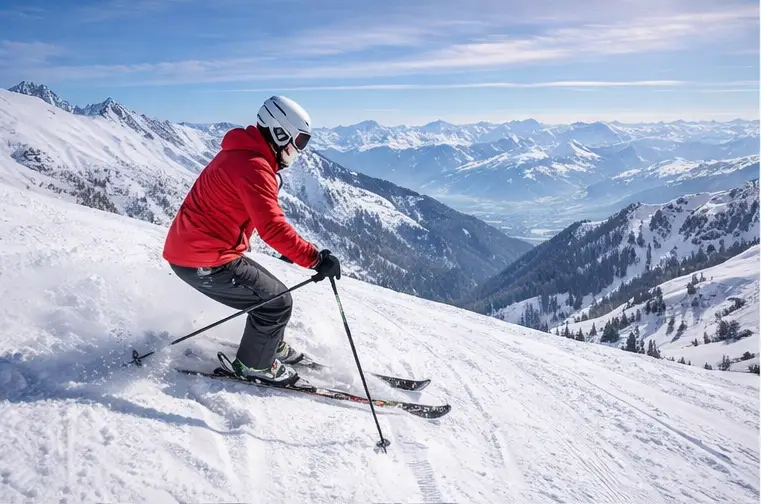
Here, you can spend the morning at altitude, carving beneath a bright Andalusian sky, then descend in little more than an hour towards the Costa Tropical or further west to the Costa del Sol, where palm trees replace pine and seafood begins to edge out fondue. It is one of Europe’s rare genuine sand-and-snow escapes, not as an abstract fantasy, but as a very practical holiday plan.
That is precisely what makes it so compelling at Easter. You are not choosing between seasons; you are slipping between them.
A few days in the mountains followed by a few on the coast feels far more modern than committing to one mood for a full week. It also suits mixed couples and families beautifully: the skier gets their spring snow, the sun-seeker gets their sea air, and everyone gets a holiday that feels richer and more cinematic than the usual single-note break.
For the adventurous: beyond the obvious
If the Alps feel too familiar and the Costa del Sol too predictable, Europe still offers wilder interpretations of the same Easter duality.
In Norway’s Lofoten Islands, ski-touring descents can run almost to the shoreline, where the landscape feels less like Europe and more like some mythic northern dream. In Iceland, skiing can be paired with geothermal pools and black-sand coasts, creating a version of spring travel that is raw, elemental and extraordinary.
These are not beach-club destinations, of course. They are for travellers who like their luxury less polished and more visceral. But as alternatives to the standard Easter script, they are unforgettable.
The first taste of summer

If snow no longer seduces you, then early April is one of Europe’s loveliest moments to head south. Not everywhere is truly beach-hot yet, but enough of the continent is warming up to make a spring-sun escape feel entirely worthwhile.
The Mediterranean is stirring rather than blazing. Sea temperatures are still cool in many places, but in the south and east they are no longer forbidding, and heated hotel pools do the rest. Air temperatures in the best spring-sun destinations are often in the low 20s, which is exactly enough for lunches outdoors, poolside reading, spa mornings, and the first tentative return of linen.
This is not high summer. That is its charm.
Canary Islands and Madeira
For dependable Easter warmth, the Canary Islands remain the easiest answer. Tenerife and Lanzarote are especially persuasive in April, when the days are long, the weather is settled, and the Atlantic feels just inviting enough. Tenerife’s highs hover around 23°C, Lanzarote’s around 24°C, and both deliver the sort of bright, easy sunshine northern Europe can only dream of at that point in the calendar.
The value is equally attractive. Seven-night Tenerife packages from around £226 per person make it one of the strongest budget spring-sun options in Europe. At the smarter end of the market, Costa Adeje’s five-star hotels and Lanzarote’s polished resorts offer a more elevated version of the same escape, often in the £600 to £800 per person range if booked in good time.
Madeira, meanwhile, is less about lying flat on a beach and more about subtropical elegance: gardens, sea views, good walking, excellent hotels and a kind of old-school Atlantic gentility that feels especially appealing at Easter.
Cyprus, Malta and the eastern Mediterranean
If you want warmer light, warmer water and a slightly more grown-up atmosphere, the eastern Mediterranean comes into its own.
Cyprus is one of the strongest April performers in Europe, with highs around 23°C and long, bright days that already feel close to summer. It is an island that knows how to do shoulder season well: enough heat for poolside living, enough breeze for comfort, and a pleasing combination of beach, mountain and village life if you want something more textured than a simple fly-and-flop.
Malta is cooler, but deeply charming at this time of year. Spring suits it. The limestone cities glow, the harbours are elegant rather than sweltering, and it lends itself beautifully to travellers who want sunshine without surrendering culture. Mellieha Bay packages in early April from about £489 per person make it a smart mid-range option, while luxury stays in places such as St Julian’s offer a more polished island break.
Rhodes, too, is quietly excellent in April — warm, bright and still blissfully shy of peak-season intensity. Seven-night packages from roughly £260 to just over £400 make it good value, especially for travellers who want both beaches and history. Antalya on the Turkish Riviera is perhaps the standout bargain of the eastern Mediterranean this Easter: warmer than many parts of southern Europe, good-looking, easy, and often available from around £260 per person for a week.
Will prices rise this year?
Almost certainly in the most obvious places. With Gulf travel disrupted and demand diverting towards Europe, countries such as Spain, Greece and Italy are likely to feel the benefit — and travellers may feel that benefit reflected in prices if they leave things too late.
That said, Europe is large, varied and wonderfully competitive. There is still value to be found, particularly if you book early, fly mid-week, or look just beyond the most predictable names. Turkey remains excellent value. Corsica may appeal to those who want something more discreet. Parts of southern Spain outside the headline resorts still offer beautifully good spring pricing.
The main rule is simple: hesitate, and you may end up paying for it.
How to choose
If your Easter ideal involves skis, altitude and a last elegant brush with winter, go high and go now. Val Thorens, Tignes, Zermatt and Sölden are still the grand names for good reason, while Sierra Nevada offers the most original twist on the classic ski week.
If you want sunshine, light skin, sea views and a head start on summer, the Canaries, Cyprus, Rhodes and Antalya all make sense, each at a different level of glamour and spend.
And if you want the sort of holiday people talk about long after it is over, choose the double act: ski first, beach later. Andalucía does it best.
Final musings
Easter is one of the last truly romantic travel weeks in Europe. It belongs neither fully to winter nor fully to summer, which is precisely why it is so alluring. The mountains are still white, the coast is already bright, and the whole continent seems to be caught in a moment of stylish transition.
That makes it the perfect time to travel well.
Go for the last snow if you must. Go for the first sun if you prefer. But do not overlook the pleasure of moving between the two — of breakfasting beneath peaks and dining beside the sea, of swapping ski goggles for sunglasses without ever leaving the same corner of Europe.
Spring is a season of transformation, and Easter travel should feel the same: a little glamorous, a little unexpected, and full of light