
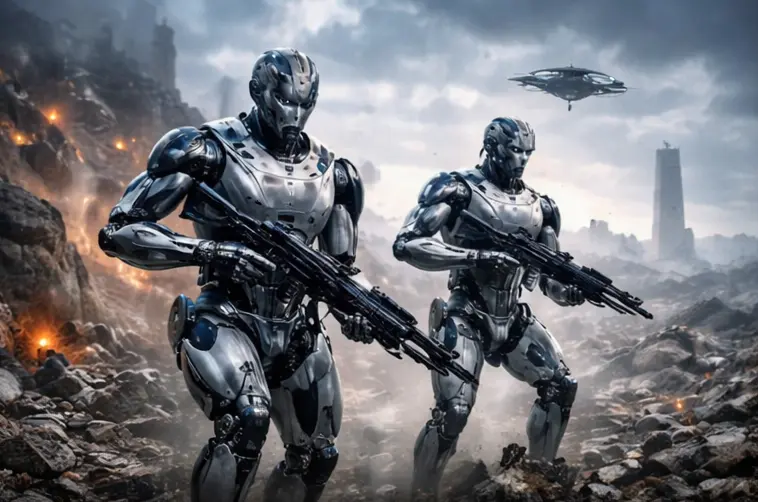
Shapeshifting Robots and AI: Are We on the Road to RoboCop or Terminator?
By Riviera Ready Magazine
How close are we, really, to a RoboCop or Terminator world?
Shapeshifting robots once belonged safely to science fiction, but in 2026 the line between cinematic nightmare and real-world technology is beginning to feel much thinner.
For years, the luxury-tech imagination has oscillated between two deliciously unsettling ideas: that governments are hiding the truth about alien life, and that machines are quietly learning how to out-think, out-work and eventually out-fight us. In 2026, both stories are back with force. Barack Obama has again stirred the UFO conversation, China is parading humanoid robots on prime-time television and placing AI-powered robot officers on city streets, ever more lifelike humanoids are being wrapped in warm synthetic skin, and — most strikingly — humanoid robots have now reportedly been sent to Ukraine for battlefield testing. The future, in other words, has stopped dressing like fantasy and started looking like a product pipeline.
Obama, UFOs and the eternal seduction of the unknown

Let us begin with the extraterrestrial angle, because it remains the most seductive and the least substantiated. In February, Obama was asked bluntly whether aliens are real. His viral answer — “They’re real, but I haven’t seen them” — was quickly followed by a clarification: statistically, given the scale of the universe, life elsewhere is plausible, but he saw no evidence during his presidency that extraterrestrials had made contact with Earth. Reuters and PolitiFact both reported that clarification, and the Pentagon’s All-domain Anomaly Resolution Office has separately stated that it has found no verifiable evidence of extraterrestrial beings, activity or technology. That is a long way from little green men in a Nevada hangar.
That does not mean the UFO story is meaningless. It means the modern version is less Close Encounters and more unresolved surveillance puzzle. Obama’s comments fit the current official mood rather neatly: curiosity, some unexplained incidents, but no proof of alien visitation. For a magazine piece, that distinction matters. The truth is not that the files prove aliens. It is that the files remain culturally magnetic because the state still does not fully explain every anomaly people hope will crack open the cosmos.
China’s robots: spectacle first, utility close behind
If the alien story remains unresolved, the robot story does not. China’s annual CCTV Spring Festival Gala — one of the country’s most watched broadcasts — showcased humanoid robots from Unitree, Galbot, Noetix and MagicLab, with martial-arts sequences, coordinated movement and recovery after falls. Reuters framed the gala not as kitsch but as industrial theatre: a very public demonstration of Beijing’s ambition to dominate humanoid robotics and AI-led manufacturing.
And the robots are not staying on stage. Xinhua reported in January that Wuhu’s “Intelligent Police Unit R001” is already assisting with traffic duties, using cameras, voice broadcasting and AI models to identify violations and warn road users, while operating in coordination with the local traffic signal system. That is not RoboCop in the cinematic sense — it is unarmed, limited and administrative — but it is very much RoboCop in the political sense: the state normalising machine authority in public space. That is usually how these transitions begin, not with gunfire, but with bureaucracy.
Liquid robots: not the T-1000, but no longer absurd either
The more exotic frontier is soft and liquid robotics. The research paper you originally flagged from Science Advances is real, and it is intriguing. Scientists described “particle-armoured liquid robots” — millimetric liquid blobs coated in superhydrophobic particles — that can navigate constrained environments, engulf and transport cargo, merge and adapt shape. PubMed’s summary of the paper makes clear these are still tiny experimental systems, not humanoid assassins melting through prison bars on command, but the conceptual echo of the T-1000 is obvious enough to make people uneasy.
That is the important distinction. We are not anywhere near a full-size liquid humanoid that can mimic a person, form weapons and hunt targets independently. What we do have are laboratory-scale demonstrations showing that robotics need not remain rigid, metallic and clunky. If hard robotics gave us the factory arm, soft and liquid robotics may eventually give us machines that squeeze through pipes, traverse damaged infrastructure, perform medical delivery or operate in hazardous environments. Terrifying in fiction, potentially invaluable in reality.
Silicone skin, camera eyes and the narrowing of the uncanny valley

If liquid robotics is about form, biomimetic robotics is about presence. DroidUp’s Moya, unveiled in Shanghai, is one of the clearest examples of where the industry is trying to go: a warm-skinned humanoid with eye-contact capability, micro-expressions, and skin temperature reportedly maintained between 32 and 36°C. New Atlas noted that its makers claim 92 per cent human-like walking accuracy, but also observed that the remaining 8 per cent is still very noticeable. That is the state of play in one sentence: impressive, eerie, and not yet convincingly human.
So has anyone made a robot that truly looks and acts like a human? Not in the ordinary, social, full-spectrum sense people actually mean. We have impressive heads, expressive faces, warmer surfaces, smoother eye contact and better gait. We do not yet have a machine that can move, converse, improvise, perceive and socially blend well enough to pass as human for extended real-world interaction. The industry is marching towards realism, but it is still marching, not arriving.
The quieter revolution: AI taking work before robots take bodies
The most immediate robot apocalypse is not metal feet on marble floors. It is software. Goldman Sachs has said generative AI could expose the equivalent of 300 million full-time jobs to automation, while McKinsey expects another 12 million occupational shifts in the United States by 2030, with customer service, office support and routine production roles particularly vulnerable. That is less cinematic than a chrome skeleton, but probably more consequential to everyday life.
Britain’s own debate reflects that split perfectly. Patrick Vallance has argued that AI and robotics will change the “human job” by taking over repetitive tasks and boosting productivity, while Sadiq Khan has warned that AI could usher in a “new era of mass unemployment” unless ministers act. Both are probably right in part. Historically, technological revolutions create and destroy work unevenly. The difference this time is speed: software scales far faster than social policy.
Driverless cars: closer than ever, but still not truly universal
Autonomous vehicles offer another useful reality check. Waymo said in May 2025 that it already had more than 1,500 vehicles operating commercially across San Francisco, Los Angeles, Phoenix and Austin, and Reuters later reported that its fleet had grown to more than 2,500 vehicles, making it the only US operator then offering paid robotaxi services without safety drivers or in-vehicle attendants. Zoox, meanwhile, is expanding in San Francisco and Las Vegas and testing in Austin and Miami. The technology is real, commercial and advancing.
But the dream of a universally capable, fully autonomous private car that you can trust anywhere in any conditions still is not here. The present reality is bounded geographies, mapped environments, specialised services and a great deal of operational caution. That is a useful lens for humanoid robotics too: progress tends to arrive first in constrained domains, not as an overnight sci-fi leap.
Humanoid Robots on the Ukrainian Battlefield
The genuinely new and significant development is that TIME reported that two Phantom MK-1 humanoid robots were sent to Ukraine in February for frontline reconnaissance support. That does not mean battalions of humanoid killer robots are suddenly fighting trench warfare. It does mean that an active war zone is now being used to test the military value of humanoid machines. That is a threshold worth taking seriously.
The deeper point, however, is even bigger. Ukraine’s own Ministry of Defence said in February that ground robotic systems completed more than 7,000 combat and logistics missions in January alone, with robots now routinely delivering ammunition, supporting logistics and evacuating the wounded in high-risk areas. Reuters also reported that Ukraine is opening battlefield data to allies and companies so they can train AI models on millions of annotated combat images. This is the real story: not simply “a humanoid robot went to war”, but that the battlefield is becoming an AI-rich training environment for increasingly autonomous machines.
The Modern War Institute at West Point puts it bluntly: Ukraine’s emerging concept is not to replace soldiers, but to keep them out of kill zones wherever possible. That is less Terminator than a brutally pragmatic, real-world proto-RoboCop logic — machines absorbing risk, extending surveillance, moving supplies, shaping decisions and gradually taking over the dull, dirty and deadly parts of combat. Once that model proves useful, militaries everywhere will study it. In truth, they already are.
So how close are we to RoboCop or Terminator?
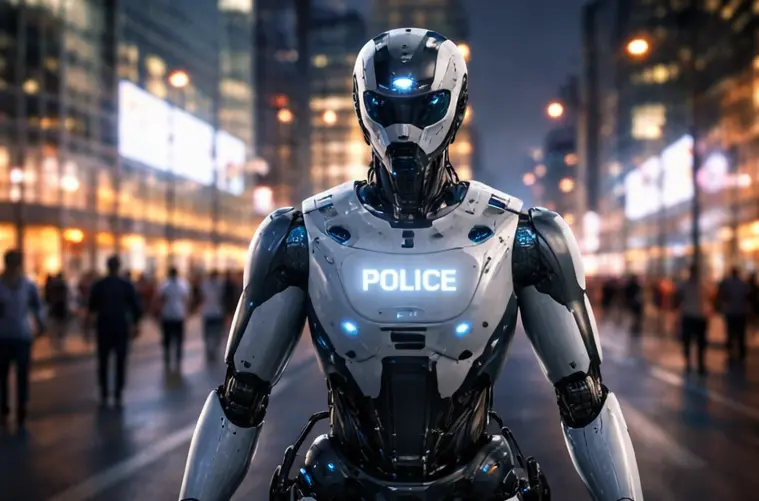
Closer to RoboCop than Terminator, and closer in fragments than in full. We have police-assist robots, robotaxis, battlefield robots, lifelike faces, warm synthetic skin, liquid micro-robots, and AI systems capable of changing labour markets before legislation catches up. We do not have conscious machine beings plotting humanity’s extinction, nor do we have any verified evidence that alien contact is guiding this transformation from the shadows. What we have is more mundane and therefore, perhaps, more serious: governments, companies and militaries steadily automating power.
The sharpest lesson is that dystopia does not usually arrive in one dramatic cinematic reveal. It arrives piecemeal: first as novelty, then convenience, then efficiency, then infrastructure. A dancing humanoid at a gala. A traffic robot at a junction. A warm-skinned service android in a station. A driverless taxi in a mapped city. A reconnaissance humanoid in a war zone. A policy memo insisting there will still be “appropriate levels of human judgment” over autonomous weapons. By the time the public asks whether the line has been crossed, the line has usually been turned into a product category.