
Behind Closed Doors: Protecting Yourself From Hotel Intruders and Hidden Threats
By Marina Zeelie
Hotel room safety has featured heavily on the news recently.
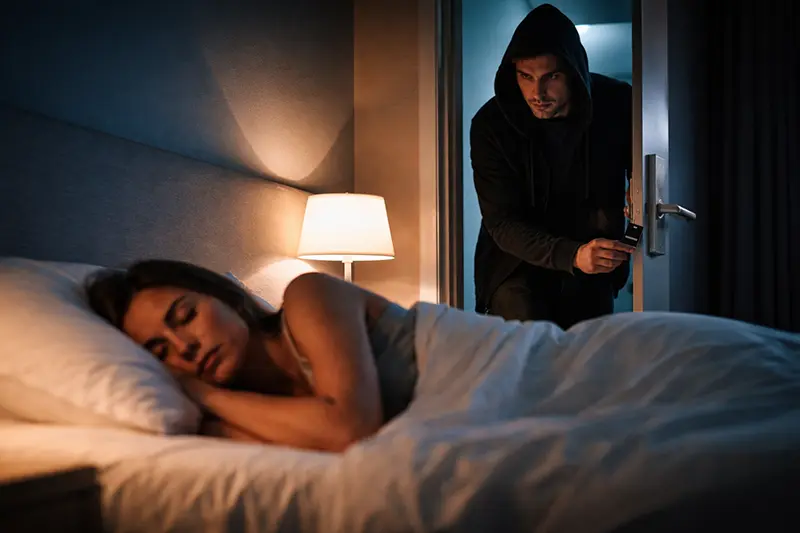
Waking up to find a stranger in your hotel bed is the stuff of nightmares. For a woman staying at a Travelodge in Maidenhead on 6 March 2026, the nightmare was real. According to police and court reports, 23‑year‑old Kyran Smith convinced reception staff he was the guest’s boyfriend and was issued a spare key to her room. He then entered the room and sexually assaulted her as she slept. Travelodge apologised and said it would overhaul its key‑issuance procedures, but the victim felt the hotel “failed her” because there was no chain or dead‑bolt lock, despite her double‑checking the door. The assault sparked outraged questions in Parliament, television interviews with Travelodge’s chief executive Jo Boydell and calls for industry‑wide reform.
The Travelodge case is not unique. In Texas, two women are suing a Fort Worth hotel after they say a front‑desk attendant escorted a man they had met outside to their room, unlocking the door with a master key; one woman was raped while her roommate showered. In Nashville, a Hilton employee was arrested in 2023 after he used a ghost key to sneak into a guest’s room and suck his toes while he slept. Such incidents illustrate that the danger in hotels is often not the technology – it is the human handing over the key. A thorough security strategy therefore requires both better industry standards and personal vigilance.
Why Hotels Remain Vulnerable
Modern hotels use electronic keycards and RFID locks, which record when a door is opened and by whom. These systems are rarely hacked, but they are only as secure as the people operating them. Many budget hotels operate with minimal staff, and the temptation to hand out a replacement key to keep the queue moving is strong. After the Travelodge assault, the chain changed its policy: spare keys will only be issued with explicit permission from the registered guest and staff will undergo additional training. The incident has prompted MPs to draft legislation requiring anyone seeking access to a hotel room to be named on the booking and imposing fines for non‑compliant hotels.
Despite these changes, there is no universal requirement for a secondary lock or chain on hotel doors. Building codes allow hotels to install deadbolts or chains as long as they can be opened from the inside without a key or tool. However, there is no model code requirement for a secondary lock, and many budget properties choose not to install them to save costs. In the United States, New York’s General Business Law §204‑a does mandate that hotels and motels with master keys provide an interior safety chain latch. Motor clubs like AAA will not list a property unless it has a deadbolt with at least a one‑inch throw and a peephole, and many higher‑end chains follow those standards. Yet the Travelodge case shows that some British hotels still lack secondary locks, and international travellers report similar gaps.
Another overlooked vulnerability is the electronic lock itself. Researchers revealed in 2024 that Saflok RFID locks used by more than 10,000 hotels worldwide could be bypassed with a customised key card, unlocking even the dead‑bolt. Only about a third of affected locks had been updated by the time the flaw became public. When your room lacks a chain or swing bar, or the electronic lock can be hacked, you have little defence once inside.
Do hotels in the UK and abroad provide secondary locks?
Most premium hotels – Marriott, Hilton, Hyatt and major European chains – fit guest‑room doors with a swing‑bar or chain and a dead‑bolt. Budget brands like Travelodge and Premier Inn often rely solely on the electronic lock and do not provide a secondary restraint; they argue that additional hardware is unnecessary because their keycard systems are secure. Some independent properties and hostels have only a single locking mechanism, while older guesthouses may still use manual keys without extra security. Because there is no UK‑wide law mandating a chain, the presence of a secondary lock varies by brand, age of the property and local fire regulations. Travellers should check the door on arrival and request a room with a swing‑bar if the existing lock feels inadequate. In some jurisdictions like New York and parts of Michigan there are specific ordinances requiring secondary locks or latches, but these are exceptions rather than the rule.
The Personal Security Toolkit
Even if your hotel has a dead‑bolt, adding a portable device can provide peace of mind. Here are some options, with their advantages and limitations:
Door wedges and alarms
Portable door wedge with alarm – These battery‑powered wedges are placed under an inward‑swinging door. When the door is pushed from outside, the wedge jams the door and triggers a loud siren. Reader’s Digest tested a door‑stop alarm that uses a 9‑volt battery, has a rubber base to prevent sliding and offers three sensitivity settings with an alarm up to 120 dB. The device fits doors with gaps of about 0.6–1.2 inches. It is inexpensive (around £10), lightweight and ideal for hotel rooms or Airbnb stays. However, it only works on inward‑opening doors; many hotel bathroom doors and some entrance doors in Europe open outwards.
DoorJammer – This award‑winning device clamps against the base of the door and the floor, creating a robust barrier. It works on most inward‑opening doors with at least ¼‑inch clearance and is certified by police agencies. It includes a quick‑release to allow emergency exit and fits easily into luggage. Price: approximately £25–£35. The DoorJammer will not fit tight doors with no clearance, and like all devices it should be removed when leaving the room – never use it as a substitute for the hotel’s own lock when you are absent.
Portable locks
Addalock portable door lock – This simple steel plate and red handle hooks into the strike plate of an inward‑swinging door and prevents the door from opening even if someone has a key card. It is small and light, works on most hotel and Airbnb doors and costs around £20. Users say there is a learning curve to fitting it, and it only works on doors that open inward and have an exposed latch plate. Remove it when leaving the room in case of emergencies.
Trustella and other heavy‑duty locks – Reviews of portable locks such as Trustella, Rerishom and AceMining point to their sturdy stainless‑steel construction and ease of installation. Kidsafe’s 2026 guide notes that the Trustella lock is TSA‑approved, protects the door frame with silicone caps and works only on inward‑opening hinged doors. Twin‑pack options like Rerishom offer value, and the AceMining lock is praised for reliability. Prices range from £15–£30. Again, these devices should never replace the hotel lock when you are away from the room.
When not to use a secondary device
Portable locks and wedges are lifesavers for many travellers, but they are not always appropriate. If you have a medical condition that may require urgent assistance – such as epilepsy, severe asthma or a heart condition – blocking entry to paramedics could be dangerous. Those who travel with a personal carer should discuss emergency access arrangements. In hotels with a single exit (common in older buildings), any obstruction could hinder evacuation in a fire. Always balance personal security with the need for rapid egress.
What if the hotel door opens outwards?
This is the awkward scenario many travel safety gadgets quietly avoid. A great number of the best-known portable hotel security devices — including under-door wedges, jammers and several of the popular latch-style travel locks — are mainly designed for inward-opening doors, not outward-opening ones. That matters, because a gadget that works brilliantly in one room may be almost useless in another.
Why ordinary wedges and travel locks often fail
If the door opens outwards, a wedge placed inside the room will usually do very little, because the door is moving away from it rather than pressing into it. The same problem applies to many of the compact travel locks sold online for hotel rooms and holiday lets: they are designed around the mechanics of an inward-opening hinged door. In other words, the very devices many solo travellers now carry for reassurance may not help at all if the door opens the “wrong” way.
What can work instead
Outward-opening doors are not hopeless, but they require a different kind of solution. There are clamp-style and no-drill travel security devices sold specifically for outward-opening doors, including products now listed on Amazon UK for hotel rooms, flats and short-term lets. The important point is not to trust the product name alone. Before buying, check carefully whether the device is explicitly designed for an outward-opening hinged door, whether it needs a certain gap or frame shape to work properly, and whether it can be removed instantly in an emergency. Compatibility appears to vary widely.
The safest practical approach
If your room door opens outwards and there is no chain, swing-bar or other internal secondary restraint, the simplest answer is often the most sensible one: ask to move rooms. Request a room with a visible internal secondary lock if one is available. If that is not possible, only rely on a portable device that is explicitly sold for outward-opening doors and, ideally, one you have already tested at home. A hotel room late at night is not the place to discover that your gadget does not fit the frame. The latest ITV reporting on the Travelodge case also notes the chain is under pressure over room-access procedures and has said it is making changes following the assault case.
DIY ideas: what helps and what does not
There is no universal DIY hack I would recommend as a fully reliable fix for outward-opening hotel doors. A wedge is usually ineffective. Anything involving tying the door to furniture, tampering with hotel hardware or creating an obstacle that could delay escape in a fire is a bad idea. The safest low-tech fallback is therefore not a clever homemade lock, but a sensible noise-and-awareness strategy: inspect the door swing as soon as you enter, test every existing lock, position luggage or another noisy object so attempted entry is more likely to wake you, and keep your phone and a torch within easy reach. It is not as reassuring as a proper secondary lock, but it is safer than relying on an improvised method that may fail.
The bottom line
For inward-opening doors, a wedge or latch-style travel lock may add genuine peace of mind. For outward-opening doors, you need a different category of solution altogether. Door direction should be part of your room safety check the moment you walk in — just like testing the main lock, checking the peephole and making sure the windows fasten properly.
Hidden Cameras: Seeing the Invisible
The thought of being watched in a supposedly private room is deeply unsettling. Hidden cameras have been found in hotels, hostels and Airbnb rentals worldwide. A 2024 CNN investigation uncovered tens of thousands of Airbnb support tickets regarding hidden cameras, with many cases not reported to law enforcement. Airbnb has since banned all indoor cameras, but enforcement is unclear. Digital Camera World notes that about 11 % of travellers may be exposed to hidden cameras and that modern detectors use RF scanning and a flashing light to reveal a camera lens. Here’s how to protect yourself:
Conduct a physical sweep
- Check common hiding places – look inside smoke detectors, alarm clocks, plug sockets, picture frames, bedside lamps and USB chargers. Hidden cameras often have a tiny hole for the lens.
- Use a torch – Turn off the lights and shine a torch (or the LED on your phone) around the room. A camera lens will reflect a small, round glint. Private investigator Paul Charman says this simple technique is more reliable than cheap RF detectors.
- Inspect mirrors – Press your fingernail against the glass; if there is a gap between your nail and its reflection, it’s a normal mirror. If the nail touches its reflection, it may be a two‑way mirror (although true spy mirrors are rare).
- Scan Wi‑Fi networks – Use a phone to view nearby networks. Names containing “IP‑camera,” “_cam” or a long string of letters may indicate a hidden device. Apps like Fing can list connected devices.
Consider a detector
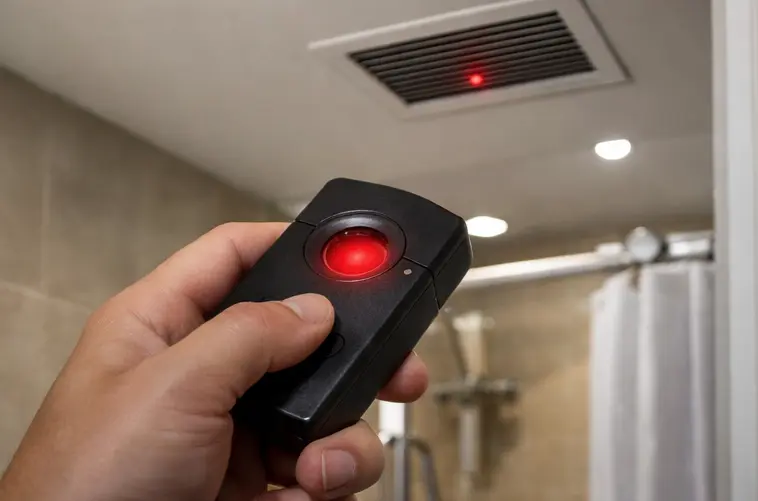
Dedicated hidden‑camera detectors combine radio‑frequency (RF) scanning with a blinking red light that highlights a camera lens. Premium models such as the JMDHKK K18 cost £60–£100 and detect both passive and transmitting cameras. However, experts warn that cheap detectors can generate false positives because hotels are full of Wi‑Fi routers and Bluetooth devices. If you purchase one, learn how to calibrate it and use the optical lens detector rather than relying solely on RF.
If you find a hidden camera
Do not touch it. Photograph it, document its location and immediately report it to hotel management and the police. If you are staying in an Airbnb, contact Airbnb’s safety team through the app and request an immediate transfer. Hidden cameras invade your privacy and may constitute a criminal offence.
Staying Safe in Youth Hostels and Shared Accommodation
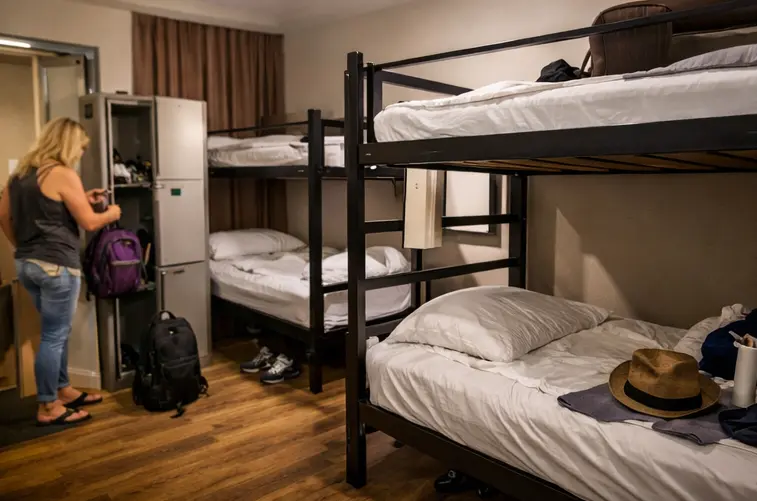
Hostels can be a wonderful way to meet people and save money, but shared rooms come with added vulnerabilities. Hostelz’s safety guide lists common concerns—ranging from theft to harassment and unwanted advances—and offers practical tips:
- Trust your instincts. If a situation feels off, leave and find another hostel. Do not hesitate to move or alert staff.
- Choose reputable hostels with good security reviews, electronic key cards and lockers. Many hostels offer female‑only dorms; pay the small extra fee if it makes you feel safer.
- Use personal padlocks and portable safes. Bring a sturdy lock for lockers and a lightweight travel safe for passports and electronics. Some travellers secure their backpack to the bed frame with a cable lock.
- Be aware of your surroundings; keep an eye on your drink and belongings in communal areas, and avoid leaving valuables unattended.
- Pack personal safety devices like a whistle, door alarm or small torch. Travel insurance with cover for theft and medical emergencies is essential.
Sleeping in a room with strangers requires constant situational awareness. Many hostels have curfews and staff on duty, but you are still responsible for your own safety. Avoid revealing your room number or schedule, and if a fellow guest makes you uncomfortable, ask to change rooms or notify staff.
Best Practices for Any Hotel Stay
Even without gadgets, simple habits can dramatically improve your safety:
- Choose the right room – Request a room on an upper floor away from stairwells and emergency exits. Ground‑floor rooms are more prone to break‑ins. Avoid rooms adjacent to lift lobbies or external doors.
- Check all locks – Upon arrival, test the electronic lock, dead‑bolt, chain or swing‑bar, patio door latch and any connecting‑door locks. If anything is broken, request a different room.
- Control your key – Don’t leave your key card in the holder with the room number visible, and never display it in public. If staff need to know your room number, show them your key card rather than saying the number aloud.
- Use all locks – When you’re inside, engage every available lock. The Washington Post recommends using the dead‑bolt and peephole, securing sliding doors, and not opening the door to strangers. Use the door viewer and call reception if someone claims to be staff but you’re uncertain.
- Don’t overshare – Avoid announcing your room number or travel plans in public spaces. When signing registration forms, write only your last name and first initial.
- Be alert to social engineering – Predators may pose as fellow guests or staff, using charm or urgency to gain your trust. If someone asks you to prop open a door or let them in, decline and notify reception.
- Secure valuables – Use the room safe or hotel safe deposit boxes for passports, cash and electronics. Never leave valuables under pillows or in plain sight.
- Report suspicious behaviour – If you see a stranger in the corridor or hear unusual noises, contact hotel security. You have a right to feel safe; raising concerns protects others as well.
- Know emergency exits – Locate the nearest fire exits when you arrive. Keep a torch by the bed in case of a nighttime evacuation.
- Check out with care – Before departure, ensure you have all belongings and have not left items in drawers or under the bed. Dispose of old key cards to prevent any personal data being read.
The Call for Industry Reform
The Travelodge assault and similar cases highlight a systemic problem: many hotels prioritise speed and cost over guest safety. Fines and reputational damage may force chains to improve training and install secondary locks. Some travellers hope that legislation will eventually mandate two‑factor authentication for room access or require chain locks. Until then, travellers—especially women and solo adventurers—must be proactive.
A safe hotel stay is a partnership between guest and host. You are paying not just for a bed but for security, privacy and peace of mind. By choosing reputable properties, verifying locks, using portable devices judiciously, and staying aware of your surroundings, you can reduce the risk of intrusion, harassment or surveillance. In the words of travel safety expert Kevin Coffey, “Don’t invite trouble; use all the locks, keep your wits about you and remember that your room is only as secure as the last person who entered it”.
In Brief: At‑a‑Glance Safety Checklist
- Before booking: read reviews for security issues; choose hotels with dead‑bolts, swing bars or chain locks.
- On arrival: inspect door, latch, peephole and windows; request a new room if locks are missing or broken.
- Inside the room: engage all locks and use portable devices like a door wedge or Addalock if appropriate; keep valuables in a safe.
- In shared accommodation: select reputable hostels, use lockers and female‑only dorms if needed, and carry a padlock and whistle.
- Hidden cameras: scan the room with a torch, check devices and unusual Wi‑Fi names and report any findings to management and police.
- Leaving the room: never leave portable locks engaged; ensure egress routes are clear and that staff can enter in an emergency.