Cannes 2026: Films, Stars, Deals and Croisette Chaos
By Brendan Bishop
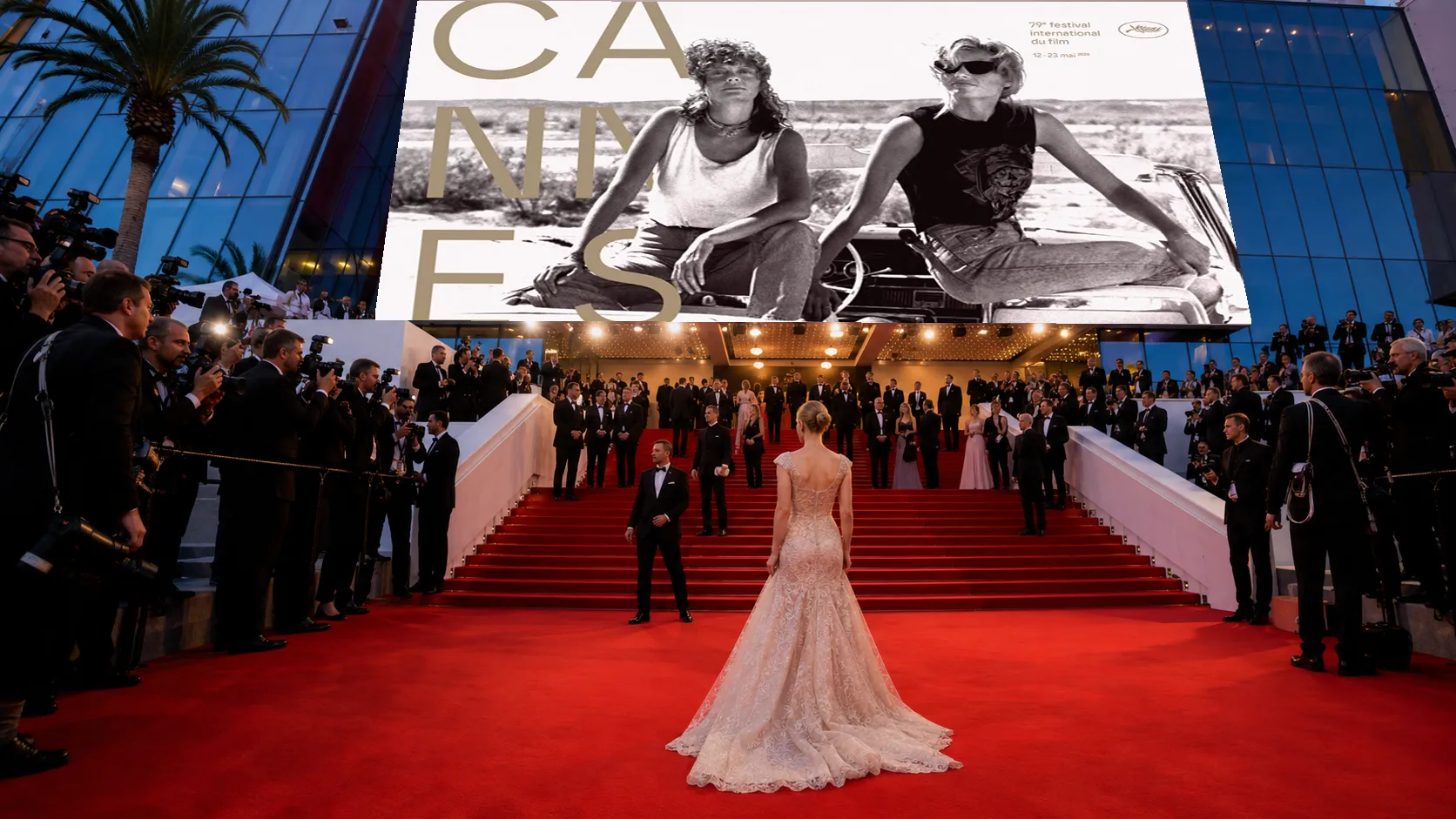
The Cannes Film Festival has always been more than a showcase for new films. It is a collision of cinema, status, money, ambition and theatre, played out for twelve days on one of the most famous stretches of seafront in Europe. The 79th Festival de Cannes, running from 12 to 23 May 2026, once again brings the world’s filmmakers, stars, financiers, journalists and hopeful gatecrashers to the French Riviera, while the Marché du Film turns the Palais des Festivals into the beating heart of the international film business.
Cannes was never meant to be ordinary
Cannes was conceived in the late 1930s as a cultural answer to political interference at the Venice Film Festival. The first event was due to open in September 1939, only for the outbreak of war to cancel it before it truly began. It finally launched in 1946, already combining serious cinema with Riviera spectacle: fireworks, parades, stars, official receptions and an instinct for pageantry that has never entirely left it.
That tension between art and theatre has defined Cannes ever since. By the 1950s, the festival had become a magnet for international celebrity, drawing everyone from Grace Kelly and Brigitte Bardot to Sophia Loren and Cary Grant. Yet it has also remained stubbornly political and sometimes combustible. In 1968, amid nationwide unrest in France, filmmakers including Jean-Luc Godard and François Truffaut helped bring the festival to a halt in solidarity with striking workers and students. Cannes is glamorous, certainly, but it has never been merely decorative.
From last year’s winners to the 2026 stage
The 2025 festival produced one of Cannes’ most resonant recent victories when Iranian director Jafar Panahi won the Palme d’Or for It Was Just an Accident. Joachim Trier’s Sentimental Value took the Grand Prix, while Kleber Mendonça Filho won Best Director for The Secret Agent. The edition also delivered major star moments: Robert De Niro received an honorary Palme d’Or at the opening ceremony, and Denzel Washington was later surprised with one ahead of the premiere of Spike Lee’s Highest 2 Lowest.
Cannes 2026 arrives with a different balance. This year’s Competition is widely seen as more auteur-driven and less dominated by large Hollywood studio films than some recent editions, but that does not mean a shortage of glamour. The festival opened with Pierre Salvadori’s period romantic comedy La Vénus électrique (The Electric Kiss), hosted by Eye Haïdara, while South Korean master Park Chan-wook presides over the main jury — a first for Korean cinema. His fellow jurors include Demi Moore, Ruth Negga, Chloé Zhao, Stellan Skarsgård, Paul Laverty, Isaach De Bankolé, Laura Wandel and Diego Céspedes.
The honours alone ensure heavyweight star presence. Peter Jackson received an honorary Palme d’Or during the opening ceremony, while Barbra Streisand is also being celebrated with an honorary Palme this year. In addition, John Travolta arrives with his directorial debut, Propeller One-Way Night Coach, adding a particularly old-school slice of Hollywood showmanship to the programme.
The films drawing attention in 2026
The Official Competition includes 22 films, with a striking concentration of internationally recognised auteurs. Among the most closely watched are Pedro Almodóvar’s Amarga Navidad, Asghar Farhadi’s Parallel Tales, Hirokazu Kore-eda’s Sheep in the Box, Ryusuke Hamaguchi’s All of a Sudden, Cristian Mungiu’s Fjord, László Nemes’ Moulin, Andrey Zvyagintsev’s Minotaur and Na Hong-jin’s Hope. Cannes in 2026 is not short of serious cinema.
It is not short of famous faces either. James Gray’s Paper Tiger brings Adam Driver, Scarlett Johansson and Miles Teller into Competition, while Ira Sachs’ The Man I Love stars Rami Malek, Rebecca Hall, Tom Sturridge and Ebon Moss-Bachrach. These are not token celebrity bookings added to brighten a red carpet; they are embedded in major Competition titles, which is precisely where Cannes glamour is at its best.
The British presence is more substantial than it may first appear. ScreenUK counts 16 UK films and co-productions across Cannes 2026, including Clio Barnard’s I See Buildings Fall Like Lightning in Directors’ Fortnight, the UK co-production The End of It in Cannes Premiere, and the documentary Cantona among the Special Screenings. The BFI and British Council are also using Cannes to spotlight emerging UK filmmakers through the annual Great 8 showcase. Britain may not dominate the main Competition this year, but it is firmly in the room.
The wider international presence is just as important. Japan is the Marché du Film’s 2026 Country of Honour, with organisers highlighting five Japanese titles in the Festival’s Official Selection and a broader programme devoted to the country’s film, animation and content industries. India, too, remains visible around the festival and market through official representation, regional cinema promotion and red-carpet appearances, though it is one strand of a much larger global picture rather than the defining story of Cannes 2026.
The Marché du Film: where Cannes earns its keep
For most of the public, Cannes means stars on the red steps. For the industry, the real machinery is the Marché du Film, running from 12 to 20 May 2026. This year, the market reports 16,000 registered participants from more than 140 countries, with 40,000 industry professionals attending the wider festival, 1,700 buyers, 600 exhibiting companies, 1,500 festival and market screenings and 250 industry events. That is why Cannes matters even to people who never set foot on the red carpet: films are financed here, sold here, packaged here and sometimes saved here.
The United States, France and the United Kingdom remain the top three countries by market attendance in 2026, according to the Marché itself. Yet the market is unmistakably global, with Asia growing strongly, Japan expanding its presence sharply as Country of Honour, and emerging national pavilions from Africa, the Middle East and Latin America continuing to push further into the Cannes ecosystem.
This is the Cannes that tourists often miss. Behind the photocalls, sales agents are presenting packages, distributors are trying to judge future awards heat, producers are seeking finance, and national film bodies are fighting for attention in a marketplace where every half-hour coffee meeting may matter. The glamour is real, but so is the hustle.
A personal Cannes connection: Jack Stall Dead
One project which I am proud to have a direct connection with in this year’s Cannes market is Jack Stall Dead, the British action thriller from JKO Films and Salman Khan Films. The film involves an investigative reporter who uncovers the deadly secrets of a global cancer-cure company and then becomes the target of mercenaries sent to silence her. Her unlikely protector is a mysterious homeless man who proves to be former special agent Jack Stall, presumed dead for four years — raising the question of why someone wanted the world to believe he no longer existed.
I worked on Jack Stall Dead both as associate producer and second-unit DoP, working alongside the extremely talented Sean Brady, who had already served as director of photography on the pilot and naturally took the lead. My own camera background is mainly in stills photography and videography for high-street fashion brands such as NEXT and House of Fraser; in film, I have worked more often as a writer and producer. Working with a large RED camera rig on a feature film is an entirely different beast, and I was glad to have Sean doing most of the heavy lifting this time.
The film’s executive producers include Guy Allon and Rajesh Nair.
The action thriller is co-directed by Ali Jacko — the former five-times world kickboxing champion — and veteran filmmaker James Simpson, who has more than 30 films to his name, including productions featuring Robert De Niro, Al Pacino, Jeremy Irons, Charlize Theron and Sharon Stone.
Ali Jacko is the driving force behind Jack Stall Dead, having written, produced, starred in and co-directed the film. A former five-times world kickboxing champion who later built JKO Films, he brings both genuine action credibility and extraordinary personal determination to the project, carrying it from script to screen with the same discipline that defined his fighting career.
The lead cast of Jack Stall Dead also includes Natasha Henstridge, Iulia Vântur, Silvio Simac, Saulius Sungi and Chris Browning.
Natasha Henstridge became an international star with her unforgettable breakout performance in the sci-fi hit Species, and went on to appear in major studio favourites including The Whole Nine Yards and The Whole Ten Yards alongside Bruce Willis and Matthew Perry, and Maximum Risk opposite Jean-Claude Van Damme.
Iulia Vântur is one of Romania’s best-known television personalities, having spent a decade as a PRO TV news presenter before becoming a familiar primetime face as co-host of the hugely popular Dansez pentru tine. She has since built a successful parallel career in India as a singer and screen performer, with prominent Bollywood credits including Race 3 and Radhe, and more recent acclaim for her acting work in the award-winning short film Echoes of Us.
Both Natasha and Iulia had demanding material to tackle and trained hard for their roles, delivering very convincingly despite each suffering unrelated off-set injuries midway through filming.
Chris Browning is a prolific American character actor with a long screen career across film and prestige television. He has appeared in major features including 3:10 to Yuma, Terminator Salvation, The Book of Eli, Cowboys & Aliens and Bright, alongside memorable television roles in Sons of Anarchy, Ray Donovan, Bosch and Westworld.
Silvio Simac brings genuine action pedigree to the film: the Croatian-born actor is also a Taekwon-do World Gold Medallist, 14-time British champion and four-time European champion, with a screen career built around high-impact roles in action titles including Transporter 3, Unleashed, DOA: Dead or Alive and Undisputed II: Last Man Standing.
Saulius Sungis adds still more physical presence to the cast. Standing at 6ft 8in, the UK-based actor plays the brother of Silvio Simac’s character in Jack Stall Dead, giving the film’s action world another imposing screen figure
The film also features strong performances from Natasha Arancini; former SAS: Who Dares Wins winner Paige Zima; actress, singer and model Tiana Sakhno, who was featured in Issue one of Riviera Ready Magazine; Maria Luz Tremsal; and a special cameo from renowned US fashion photographer Joshua Michael Shelton, who flew from Los Angeles for his scenes and also took the incredible on-set stills for the film. Josh has also just finished post productio on Punkture, a film which he wrote and directed, starring Jay Tavare and Jay Irwin, and he will be taking it onto the festival circuit this year.
The scale of the stunt work was one of the most striking parts of the production. On some of the larger fight sequences, there were 40 to 50 stunt performers involved in a single scene, creating a genuine sense of physical mass and impact rather than relying on the illusion of action. The film’s fight choreography and stunt coordination were led by Samuel “Kefi” Abrikh.
Most people do not realise just how much work and commitment goes into making an independent film. That commitment started at the top: Ali Jacko used his world-champion determination to get this project off the ground and in the can, surviving on only a few hours’ sleep a day for months on end. On independent films, budgets are usually far smaller than on studio productions, which often means smaller crews and longer hours on set. Executive producer and line producer Guy Allon also survived on a few hours’ sleep a day, production manager Joynal Abdin sometimes doubled up as chef, and every member of the cast, crew and stunt team gave their all to make it happen. It is extremely satisfying to see the film reaching this stage.
The Raindance Villa Party
For British independent filmmakers, perhaps the most keenly anticipated social and networking event of the festival is the annual Raindance Villa Party in Cannes, hosted by Elliot Grove, founder of Raindance and the British Independent Film Awards, alongside actor-producer Sean Cronin of Magnificent Films. Now in its 12th annual edition, the 2026 party takes place at a private Cannes villa on 17 May, bringing together filmmakers, producers, sales agents, actors and festival regulars in a more relaxed setting than the frantic corridors of the Palais.
Raindance itself describes the gathering as “one of the most anticipated networking events of the festival”, and for Britain’s independent film community it has become a genuine Cannes institution — part party, part reunion, part opportunity to make the sort of chance connection that can still matter enormously in the film business.
When the Croisette locks up
There is, however, another Cannes entirely — the one you experience on foot.
The Grand Théâtre Lumière at the Palais hosts two evening gala screenings each night, generally around 7pm and 10pm, and when a major premiere is building the whole area becomes a controlled performance space. The red carpet is not merely laid out; it reorganises the town around itself. The road in front of the Palais and sections of the Croisette become difficult or impossible to cross in the usual way. Pedestrian flow is redirected. What looked like a simple five-minute walk on the map can suddenly become a long, slow negotiation through crowds, barriers and diverted foot traffic.
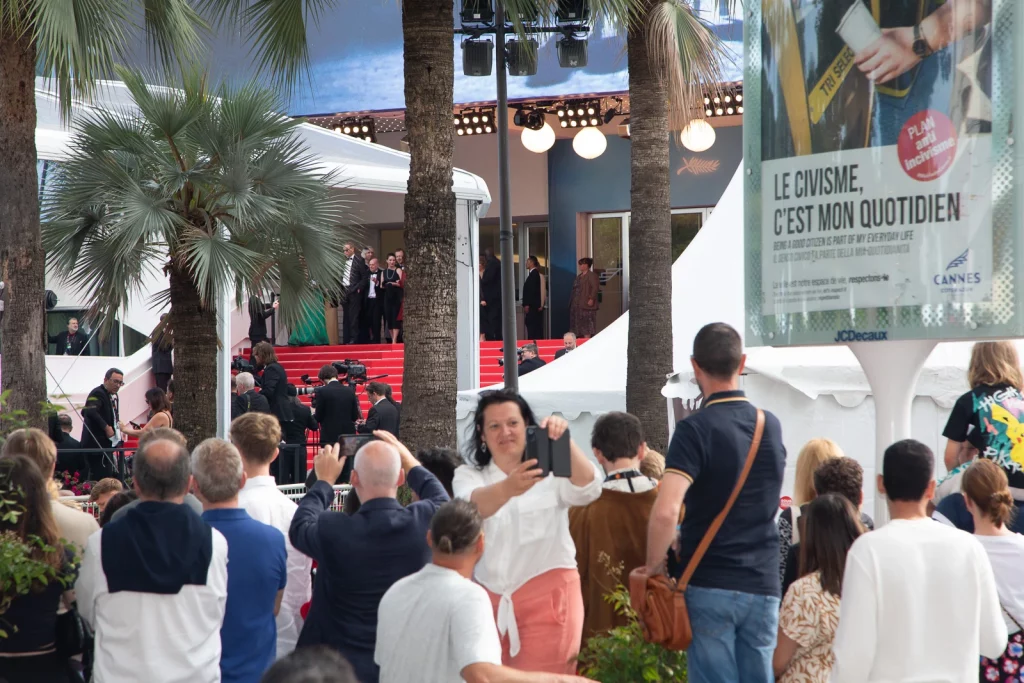
Anyone with meetings in the Marché, a panel to attend, or a screening to reach needs to factor this in. Cannes is not forgiving if you misjudge the timing. There is a useful workaround if you hold the right accreditation: walking along the marina behind the Palais can be longer in distance but far quicker in practice, because it avoids the worst of the Croisette gridlock.
And this is when the festival’s particular madness becomes most visible.
As the cars begin to sweep towards the Palais and the photographers gather, you will often see men and women standing on the pavement in full formal wear: women in gowns or cocktail dresses, men in dinner suits, sometimes alone, sometimes as couples, holding handwritten signs asking for a spare invitation. Not offering to buy one. Not trying to haggle. Simply hoping someone will give them a ticket. It is one of Cannes’ most surreal traditions, and it has been observed for years by festival veterans and critics alike.
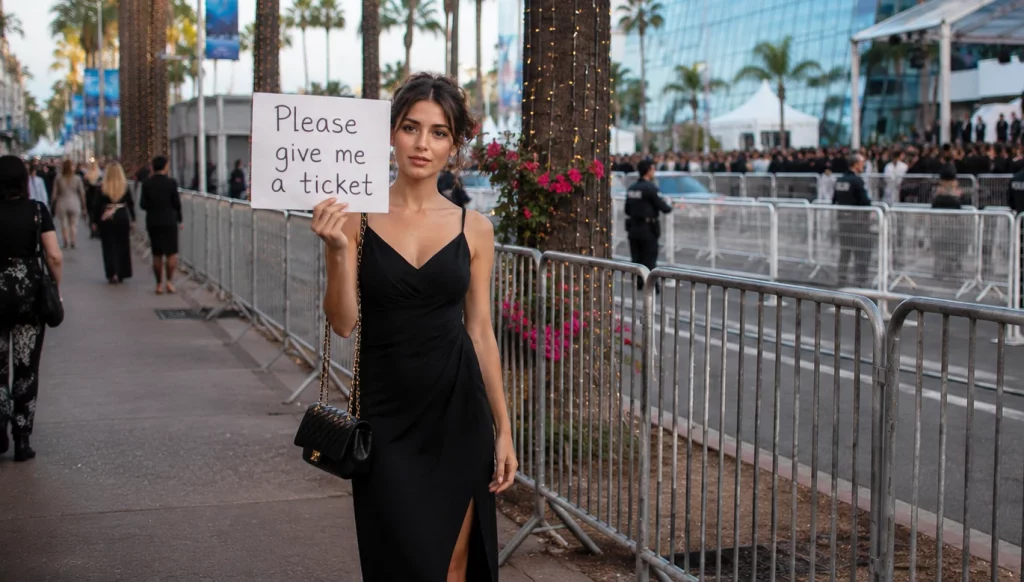
The reason it looks so strange is that official Cannes screenings are not run like a normal public cinema. Access to the Festival’s screenings is by invitation; the invitations are free, strictly personalised and non-transferable, and the Festival states plainly that ticket sales are prohibited. In theory, then, there should be no secondary market. In practice, as with almost everything in Cannes, desire finds a way to make itself expensive.
One of the oddest things I have seen near the Croisette during a premiere build-up was a smartly dressed man holding a sign up towards the procession of VIP cars. It read: “I want to be an actor”, followed by his phone number. There was something both ridiculous and oddly admirable about it — Cannes reducing the entire dream of the film business to a placard on a street corner.
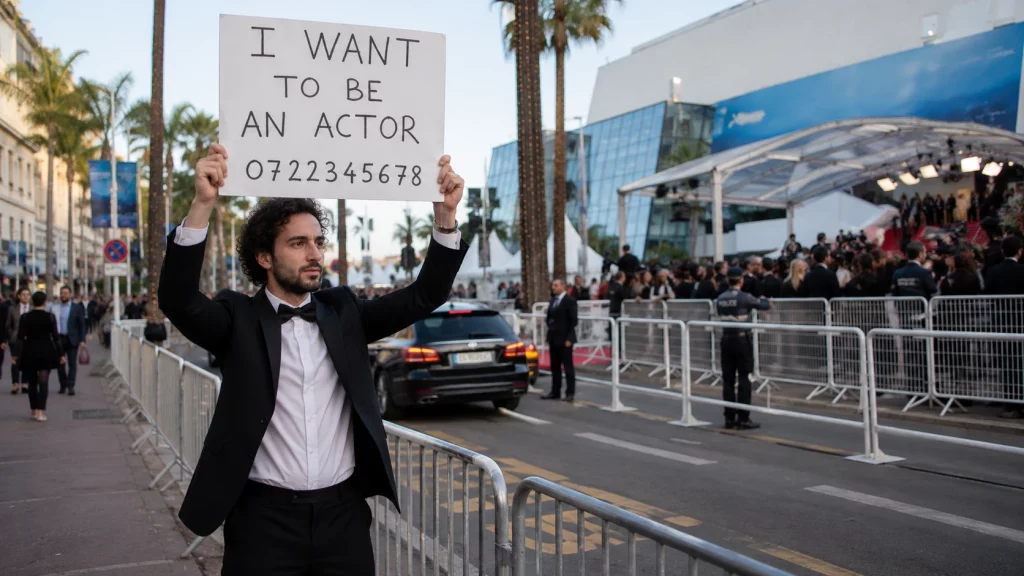
When I saw him, and the line of beautifully dressed ticket hopefuls nearby, I joked to a friend that the next year I should return with my own sign saying: “Give me £1 million”, followed by my PayPal address. At least it would be honest.
Glamour, amfAR and the price of access
If the official festival is disciplined, the parallel Cannes universe is anything but. Private dinners, yacht receptions, brand parties, rooftop gatherings and hotel takeovers multiply across the fortnight. Some are serious networking events; some are pure social theatre; most are a little of both. Cannes remains one of the few places where a director, a billionaire investor, a fashion house ambassador, a distributor, a celebrity stylist and a first-time producer can all plausibly end up in the same room before midnight.
The most famous side event is the amfAR Gala Cannes, held on 21 May 2026 at the Hôtel du Cap-Eden-Roc in Cap d’Antibes. This year’s gala is hosted by Geena Davis, with performances from Robbie Williams, Zara Larsson and PinkPantheress, plus a DJ set from Honey Dijon. Event chairs include figures such as Pedro Almodóvar, Angela Bassett, Rachel Brosnahan, Colman Domingo, Scarlett Johansson, Demi Moore, Michelle Yeoh and Jeffrey Wright.
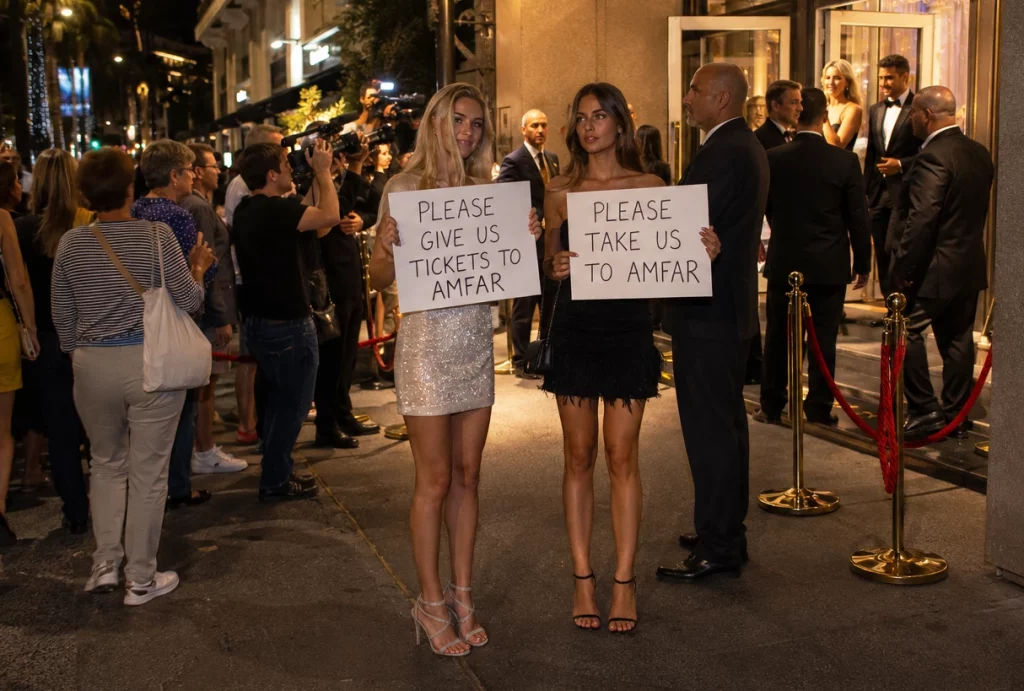
The prices are just as staggering as the guest list. Official 2026 amfAR access begins at €17,500 for a Supporter Ticket, rises to €40,000 for a Philanthropist Ticket, and reaches €300,000 for the top table package. That is the legitimate route. Outside it, Cannes has long attracted brokers and touts trying to monetise the desperate desire to be in the right room. In 2025, Screen Daily reported black-market pitches for premiere and party access running into the thousands of dollars. The official rules are clear; the unofficial appetite is equally clear.
Dress code and etiquette

Cannes still takes its rituals seriously. For Grand Théâtre Lumière gala screenings, the Festival requires formal evening wear: long gowns or tuxedos, with certain elegant alternatives accepted. Trainers are not allowed for gala screenings, large bags are banned, and the Festival has now made explicit that nudity and excessively voluminous outfits which impede movement or seating are not permitted on the red carpet. Personal selfies, photos and filming on the steps are also prohibited.
For accredited guests, punctuality matters more than confidence. Once a screening seat has been allocated, Cannes guarantees it only up to a point: for gala screenings at the Grand Théâtre Lumière, your seat is held until 25 minutes before the screening. Beyond that, the Festival needs to manage entry, flow and security. It is not a place to arrive fashionably late unless you are one of the people everyone else is there to watch.
For readers travelling from Britain, the practical route is still usually Nice Côte d’Azur Airport, followed by road or rail towards Cannes. The official festival travel guidance notes that Express Bus 81 runs from Nice Airport Terminal 2 to Cannes SNCF station in around 45 minutes, with the Palais a short walk away. Once in town, accredited festival-goers can also use the PalmBus network with the Festival Pass QR code during the edition.
And for those without accreditation, Cannes is not entirely sealed off. The Cinéma de la Plage remains one of the festival’s most charming public-facing traditions, offering free open-air evening screenings on the beach from 9.30pm. It is a useful reminder that, beneath the security lines and exclusivity, Cannes still belongs to cinema lovers too.
After Cannes: the Riviera rolls on to Monaco
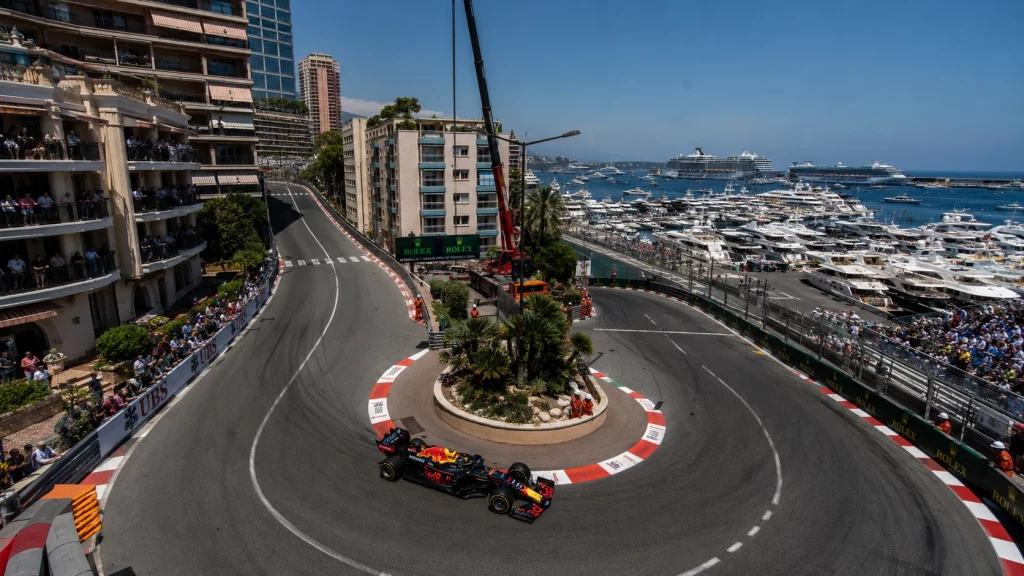
Cannes does not quite hand the Riviera back when the closing ceremony ends. Less than two weeks later, attention shifts east to the Formula 1 Monaco Grand Prix, taking place from 4 to 7 June 2026, with the race itself on Sunday 7 June. The crossover is natural: the same Côte d’Azur appetite for spectacle, yachts, celebrity and money simply migrates from red carpets to harbour views and pit lanes.
For visitors with the means — or the endurance — combining Cannes and Monaco remains one of the Riviera’s great maximalist itineraries. One fortnight is about cinema, the next about speed. Both are about access, theatre and the ancient pleasure of watching other people arrive in better cars than yours.
Cannes still matters
Cannes in 2026 is not a relic, and it is not merely a celebrity carousel. It remains a place where films can be launched into world conversation, where a festival screening can alter a director’s career, where the business of cinema is conducted with extraordinary concentration, and where the ridiculousness of the whole enterprise is never far from view.
That is why Cannes endures. It is high art and hard commerce, careful curation and shameless peacocking, one of the most serious cultural events in the world and, at street level, occasionally one of the funniest. On the Croisette, both truths can exist at once.
I’ve merged both drafts, rebuilt the piece around the stronger international/Croisette angle, rechecked the 2026 facts against live sources, and kept India to a brief, proportionate mention rather than a featured section. I also folded in your first-hand Croisette material as a central set-piece, which is far more distinctive than a generic festival preview.
For a closer examination of the reduced American studio presence, read our analysis of Hollywood at Cannes 2026.
References and further reading
- Festival de Cannes — The History of the Festival
- Festival de Cannes — 50 Years Ago, the Revolt of May ’68 Sweeps the Festival de Cannes
- Festival de Cannes — The Films of the Official Selection 2026
- Festival de Cannes — Park Chan-wook, President of the Jury of the 79th Festival de Cannes
- Festival de Cannes — The Jury of the 79th Festival de Cannes
- Festival de Cannes — Eye Haïdara, Mistress of Ceremonies for the 2026 Festival de Cannes
- Festival de Cannes — La Vénus électrique by Pierre Salvadori, Opening Film of the 79th Festival de Cannes
- Festival de Cannes — Peter Jackson, Honorary Palme d’Or of the 79th Festival de Cannes
- Festival de Cannes — Barbra Streisand, Honorary Palme d’Or of the 79th Festival de Cannes
- Festival de Cannes — Admission to Screenings
- Festival de Cannes — Festival-Goer’s Charter 2026
- Festival de Cannes Help Centre — What Are the Conditions of Access to the Screenings?
- Marché du Film — The Marché du Film Maintains Record Levels of Participation and Confirms its Global Leadership
- Marché du Film — Japan Named 2026 Country of Honour at the Marché du Film
- Festival de Cannes — Meet the 78th Festival de Cannes Winners
- Reuters — Cannes Film Festival 2026 Explained: Contenders, History and Who’s Attending
- Reuters — Denzel Washington Receives Surprise Honorary Palme d’Or Award at Cannes
- ScreenUK — Cannes 2026: UK Films and Co-Productions
- BFI — Great 8 Showcase Revealed for Cannes 2026
- amfAR — amfAR Gala Cannes 2026
- amfAR — amfAR Gala Cannes 2026 Ticket and Table Packages
- Screen Daily — “Pure Auteur Fuel”: How Cannes’ Black Market Touts Are Pitching $6k Tickets
- Formula 1 — Monaco Grand Prix 2026
- Automobile Club de Monaco — Formula 1 Louis Vuitton Grand Prix de Monaco 2026
- Raindance — The Art of Film Industry Networking: From Raindance to Cannes and Beyond
- Raindance / Eventbrite — Raindance Villa Party in Cannes, 17 May 2026
- Raindance — 30th Anniversary Cannes Villa Party & 2 Day Film School
- Raindance — Press Releases
- Fantastic Films International — Jack Stall Dead Trailer
- Fantastic Films International — New Titles
- JKO Films — Jack Stall Dead
- Simpson Films — About James
- Samuel Kefi Abrikh — Filmography
- Samuel Kefi Abrikh — Profile
- IMDb — Jack Stall Dead
- IMDb — Jack Stall Dead Full Cast & Crew
- IMDb — Ali Jacko
- IMDb — Natasha Henstridge
- IMDb — Iulia Vântur
- IMDb — Chris Browning
- IMDb — Silvio Simac
- IMDb — Saulius Sungis
- Oh So Small — Saulius Sungis
- Wish You Were Here: Maryna Marynchenko on Life in Cannes and the Allure of the French Riviera
- The Most Exclusive Hotels in the World