
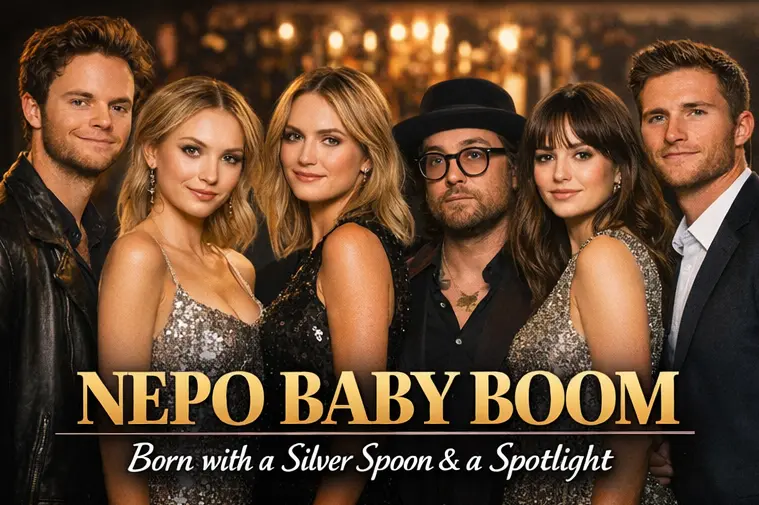
Nepo Babies: Hollywood, Music and the Price of Privilege
By Felicity Attwood
Nepo babies have become one of modern celebrity culture’s favourite arguments: a shorthand for famous children, inherited access, public resentment and the uneasy question of where privilege ends and talent begins.
There are few things the public enjoys more than watching a celebrity child insist they emerged from nowhere but pluck, grit and an old iPhone. It is not that audiences object to famous parents helping their offspring. Most people accept that of course they do. The irritation begins when a child raised around agents, labels, stylists, casting directors and private screening rooms is presented as some miraculous waif discovered in the digital wilderness. Nepotism is rarely the whole story, but it is very often the opening chapter.
And the current cast is hardly short of surnames with a little pre-installed sparkle. Gracie Abrams is the daughter of J.J. Abrams and Katie McGrath; Bono’s son Elijah Hewson fronts Inhaler; Violet Grohl has now launched her own solo music after years of performing with her father; Kate Hudson is Goldie Hawn’s daughter; Miley Cyrus came up through Hannah Montana with Billy Ray Cyrus in the family frame; and Dhani Harrison has carried one of the most mythic surnames in music since birth. Talent may be real, but so is proximity to power, and proximity is often the most valuable currency in showbusiness.
The Lily Allen Myth: Talent, Timing and Family Connections
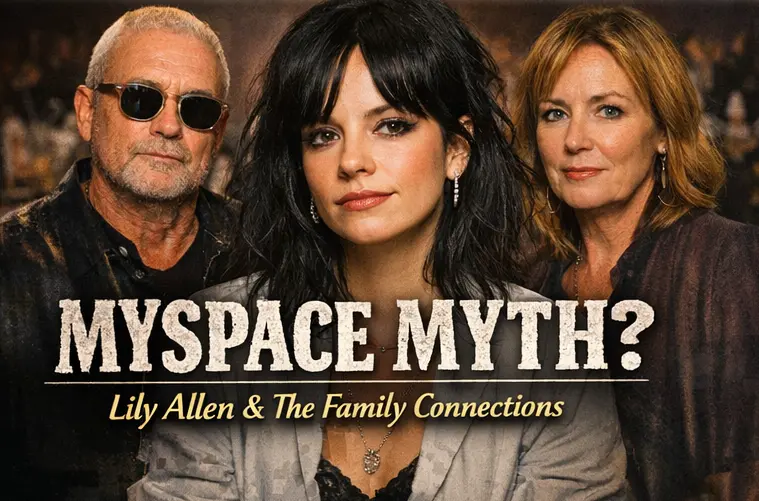
Lily Allen is one of the most delicious examples because the public story was packaged so neatly. For years, the tale went something like this: quirky teenager, bedroom recordings, MySpace, instant discovery. Very democratic. Very modern. Very convenient. The trouble is that the family tree was doing rather a lot of heavy lifting behind the curtain. Her father, Keith Allen, was already a known actor and co-creator of Fat Les’s Vindaloo, which Official Charts records as spending three weeks at No. 2 in 1998. Her mother, Alison Owen, was not some stage-school mum with a Filofax, but an established film producer. Lily herself later grew up around a showbusiness world that included figures such as Joe Strummer, Damien Hirst and, for a period, Harry Enfield in the family orbit.
More awkwardly for the “discovered online” legend, The Guardian reported that Allen’s first record deal, when she was 16, was facilitated by family connections, and another Guardian piece notes that Keith Allen used his contacts to help secure that early deal. That does not mean Lily Allen lacked talent. It means the cleaner version of the story is also the more honest one: MySpace helped, but she was not some industry orphan singing into the void. She was a talented young woman with a father fresh off one of Britain’s biggest football anthems, a producer mother with heavyweight contacts, and a front-row education in how the business worked. That is not fraud; it is privilege. Let us at least call it by its proper name.
The ones who admit it look much better in the daylight
The smarter nepo babies have realised that denial is now less chic than candour. Maya Hawke has been notably frank, saying she is comfortable with having a life she may not “deserve”, rather than pretending the universe randomly threw Ethan Hawke and Uma Thurman into her family tree by clerical error. Kate Hudson has brushed off the whole debate with the argument that storytelling runs in families and that hard work still matters. That sort of honesty tends to land better than the old routine in which a starlet acts as though she simply bumped into a producer while buying chewing gum.
And then there are the ones who tried to sidestep the obvious
Scott Eastwood spent part of his early career using Scott Reeves, even though Interview Magazine noted the whole point quite plainly: everyone wanted him to use Eastwood, and he refused until eventually giving in. One can only admire the effort. But really — who exactly did he think he was kidding? The jaw, the squint, the voice, the whole sun-baked cowboy arrangement: he looks like Clint Eastwood’s mini-me, only with a few inches shaved off the original mould. When a man resembles his father that closely, changing the surname is less a disguise than a party trick.
Emilio Estevez is the more respectable variation on the theme. Unlike his father, born Ramón Estévez and later known professionally as Martin Sheen, Emilio kept the family name. Admirable, yes. Principled, certainly. But subtle? Not remotely. The Guardian has noted both that Martín/Sheen took a stage name early in his career and that Emilio never did; it has also written, with rather perfect understatement, that Emilio now has his father’s looks. Quite. He does not merely resemble Martin Sheen. He looks and sounds so much like him that the game was up before anyone reached the closing credits. The idea that either Emilio Estevez or Scott Eastwood could quietly slip away from paternal comparison was always faintly comic. Genetics, alas, are terrible at respecting PR strategy.
When a Famous Name Becomes a Burden
That is the part the champagne-soaked gossip often misses. A famous surname does not merely open doors; sometimes it walks into the room ahead of you, wearing other people’s grudges. Zosia Mamet told The Guardian that growing up around the industry may indeed have opened some doors, but that she often arrived carrying “baggage”, including other people’s feelings about her father. Emma Roberts said something similar in 2024, saying she had lost more jobs than she had gained because of her family name and the opinions people held about her relatives. So yes, the privilege is real — but so is the resentment. A famous name can be both a pass and a penalty.
Sometimes the curse is worse when you never wanted the spotlight at all
The bleakest version of this story belongs not to the ambitious daughters of Hollywood, but to the relatives who never asked to join the circus in the first place. Elton John’s half-brother Geoff Dwight has spoken publicly about how far his own life diverged from the Elton fantasy. Reporting in The Independent and Smooth Radio notes that Geoff, who lives in Ruthin in North Wales, said he had spoken to Elton only once since their father Stanley’s death in 1991 and criticised Rocketman for depicting a father he said was “not the dad I remember”. That alone tells you plenty: same family, same father, radically different inheritance of memory and status.
And then there is the tabloid side of it, which is uglier still. British press coverage has long feasted on the contrast between Elton’s wealth and Geoff’s leaner, more precarious life, including reports that money once became so tight that Geoff rented out his home and lived in a shed in the garden. Whether one reads those accounts with sympathy or with a raised eyebrow, the broader point is undeniable: being related to someone world-famous does not guarantee money, protection or dignity. Sometimes it simply means that your hardships are photographed more gleefully, because the surname makes the story sell. That is not a leg-up. That is collateral damage with a famous relative attached.
So should nepo babies hide it, or own it?
They should own it, because concealment is usually more ridiculous than the privilege itself. Nobody minds a famous child saying, “Yes, of course I had an advantage — now let me show you whether I can actually do the work.” What grates is the dainty fiction that they made it entirely alone while travelling first class through an industry their parents already knew intimately. Doors open faster for some people. That is life. But trying to pretend the door was never opened at all is what really makes the room turn chilly.
Felicity’s Final Word: Privilege Is Easier to Forgive Than Pretence
The nepo baby debate was never really about talent. Some celebrity children are brilliant. Some are dreadful. Most are somewhere in the perfectly ordinary middle, just like the rest of humanity. The real issue is honesty. Lily Allen was not an accidental MySpace Cinderella. Scott Eastwood was never going to pass for the milkman’s son. Emilio Estevez may have kept the family name, but his face was doing all the talking anyway. And Geoff Dwight stands as the melancholy reminder that a famous surname can be a burden even when it brings none of the glamour.
In other words, the public can forgive privilege far more easily than pantomime. If you were born with the backstage pass, darling, at least have the manners to stop calling it a raffle ticket.