
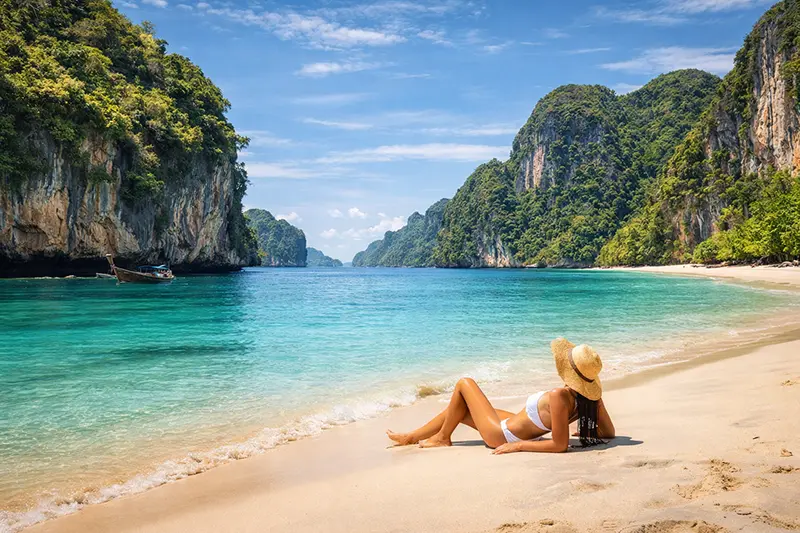
Thailand Travel Guide: The Real Paradise Behind the Fantasy
By Marina Zeelie
The Myth of Paradise: Thailand Beyond the Brochure
Thailand remains one of the world’s great travel fantasies, but any honest Thailand travel guide has to look beyond the turquoise beaches and golden temples to the costs, laws, safety questions and cultural realities beneath the postcard sheen.
When Alex Garland’s The Beach arrived in 1996 it cast Thailand’s islands as Eden: a secret cove where backpackers could live cheaply and free of rules. A few years later Danny Boyle’s film adaptation, starring Leonardo Di Caprio, pushed Maya Bay’s turquoise water and limestone cliffs onto cinema screens worldwide. British girl group All Saints topped the UK charts in February 2000 with “Pure Shores,” the film’s dreamy theme tune. The combination of novel, film and pop song launched Thailand as the ultimate gap‑year escape and kept it there for a generation.
Twenty‑five years on, Thailand’s beaches and temples remain a pilgrimage for backpackers and luxury travellers alike. The country’s tourist board markets the “Land of Smiles” as a place of eternal summer, friendly people and spiritual calm. Social media has only accelerated the dream. Influencers fill feeds with images of yoga on the sand, sunset cocktails and golden temples, often repeating the mantra that life here is cheap – more affordable than London or New York, they say – with abundant sunshine and eternal parties. But beneath the turquoise veneer lies a much more complex reality. Environmental damage, crime, corruption and human‑rights abuses shadow the paradise narrative. For the traveller contemplating a sabbatical, remote‑working stint or permanent move, it is worth examining both sides.
Living the Dream: Thailand Costs, Visas and Influencer Life
Low rents and affordable lifestyles. Bangkok is dramatically less expensive than London. Numbeo’s March 2026 figures show that a one‑bedroom apartment in central Bangkok averages ฿21,854 (£506) per month, with a range of ฿15,000–30,000 (£347–694). Outside the centre the average rent falls to ฿10,686 (£247). Wise’s 2025 cost‑of‑living guide lists similar figures: ฿15,956 (≈£369) per month in a city‑centre one‑bedroom flat and ฿8,789 (≈£203) outside the centre. Beach destinations are pricier – Expatistan’s 2026 data for Phuket shows that an 85 m² furnished apartment in an expensive area averages ฿41,099 (£951) per month, whereas a similar unit in a normal area is ฿21,870 (£506); a 45 m² studio costs ฿30,297 (£701) in an upmarket district and ฿14,541 (£337) in a less fashionable one. By comparison, typical London rents are more than triple these rates. A 2025 Siam Real Estate guide suggests that in Bangkok a one‑bedroom flat costs US$250–500 (£195–390) per month, while rents in smaller towns can be as low as US$100 (£78); it estimates total living expenses at US$700–1,000 (£546–780) per monthsiamrealestate.com.
Digital nomads and influencers. Thailand’s combination of low overheads, fast internet and a lively expat scene draws thousands of remote workers and content creators. The Thai government even introduced a Destination Thailand Visa in July 2024: a five‑year multiple‑entry visa that allows stays of up to 180 days per entry and targets digital nomads, freelancers and remote employees. Applicants must prove at least ฿500,000 (≈£11,575) in savings or equivalent assets and cannot work for a Thai employer. Other options include the long‑term Thailand Elite visa and the Long‑Term Resident visa, which exempts foreign income from Thai taxes. Travel bloggers often extend their stay with successive tourist visas or visa runs, but immigration officials may refuse entry if they suspect illegal work.
Remote workers based in Europe or the U.S. can maintain their salaries while spending far less than at home. A mid‑range digital nomad budget (comfortably furnished apartment, eating out regularly, occasional weekend trips) runs ฿45,000–65,000 (£1,042–1,509) per month according to an April 2025 Voyay guide. A frugal lifestyle – staying outside city centres, eating street food and limiting nightlife – can drop to ฿35,000–45,000 (£811–1,042). Upscale living with high‑end dining and frequent domestic flights starts at ฿65,000 (£1,509). Add to this the ease of renting scooters (฿3,000–4,500 per month) and coworking spaces (฿3,000–5,000 per month), and it is easy to see why foreign influencers film themselves “living like kings.”
How influencers earn. Many content creators monetise their Thai lives through YouTube ad revenue, affiliate links and brand partnerships. Others sell online courses on dropshipping, cryptocurrency or “how to move to Thailand” e‑books. While some legitimately share travel advice or showcase Thai cuisine, there is also a darker thread: channels promoting sex tourism or overstaying visas for “private tours.” The audience demand for videos from Thailand is huge, but prospective movers should be wary of unrealistic earnings claims; remote work remains a safer and more sustainable route than hoping to become a viral influencer overnight.
The darker truth: crime, drugs and corruption
Violence against travellers. Thailand’s overall homicide rate remains relatively low – 1.84 per 100,000 people in 2021, rising to 2.6 in 2024 – but a handful of high‑profile crimes have tarnished its image. In September 2014 the bodies of British backpackers Hannah Witheridge and David Miller were discovered on Koh Tao; Witheridge had been raped and both were beaten to death. The case exposed police incompetence and allegations of scapegoating and led some travellers to dub Koh Tao “Death Island.” Fourteen years earlier, in August 2000, 23‑year‑old Kirsty Jones from Wales was found raped and strangled in a Chiang Mai guesthouse. The Guardian reported that other backpackers heard screams but assumed it was a lovers’ quarrel; the case remains unsolved. More recently, in August 2023, Spanish YouTube chef Daniel Sancho Bronchalo murdered and dismembered Colombian surgeon Edwin Arrieta on Koh Phangan. He claimed self‑defence but was convicted of premeditated murder and given a life sentence.
These tragedies are outliers – millions of visitors come and go safely each year – yet they reveal systemic issues. The chaotic investigation into the Koh Tao murders, for example, highlighted how local power structures and tourism revenues can obstruct justice. Female travellers have been attacked in remote areas, and the British Foreign Office still warns solo women to be vigilant, avoid accepting drinks from strangers and check taxi details before entering. After The Beach film, Rough Guide noted a sharp increase in single women backpacking to Thailand; a representative told journalists that one murder would not deter travellers but emphasised the need to follow safety guidelines.
Draconian drug laws. Thailand’s lush hills once nurtured opium fields, and drug trafficking remains a regional menace. In recent years the country has experimented with decriminalising cannabis (possession of products with less than 0.2% THC is allowed), but penalties for hard drugs are harsh. The Thai Embasy explains that under the Narcotics Act production, importation or exportation of Category I drugs can lead to life imprisonment or the death penalty. Possession or distribution of small amounts still carries lengthy prison sentences and fines. Unwary backpackers have been caught with recreational pills that turn out to be illegal; others have faced severe consequences after drugs were planted in their luggage by strangers. Anyone considering a full moon party should keep their wits about them and decline offers of “happy shakes.”
Sex work and trafficking. Thailand is often portrayed as a sexual playground. While prostitution has been illegal under the Prevention and Suppression of Prostitution Act (1996), the industry continues to generate billions of pounds. An estimated 200,000 people work in sex services, many from impoverished backgrounds or neighbouring countries. Bars and massage parlours openly advertise “bar fine” systems, and older Western men seeking companionship or even “brides” are part of the clientele. A draft Sex Workers Protection Bill, under parliamentary review, would decriminalise adult sex work, set a minimum age of 18, and provide protections while maintaining strict penalties for minors and trafficking. Until such reforms pass, the legal grey area leaves sex workers vulnerable to exploitation and police extortion.
Human trafficking remains a serious problem. The United States’ 2025 Trafficking in Persons report notes that Thailand prosecuted 647 suspected traffickers in 2024 (547 for sex trafficking) and convicted 360, with most receiving sentences of at least two years. Yet NGOs warn that labour‑trafficking victims are seldom identified because officials often fail to recognise debt‑based coercion and are reluctant to pursue cases. Corruption and official complicity allow traffickers to operate with impunity; immigration and law‑enforcement officers have accepted bribes to facilitate trafficking routes, and no complicit officials were convicted in 2024. A CSIS analysis notes that nearly 50 % of Thai citizens admit to bribing police, and even the national police chief admitted receiving an $8.8 million “loan” from the owner of a massage parlour associated with human trafficking. Low wages and the normalisation of bribes undermine public trust.
Stray animals and animal welfare
Thailand’s street dogs – known as soi dogs – are both beloved and a public‑health challenge. A 2017 study estimated that the country had 8.5 million dogs, of which around 730,000 were abandoned. Bangkok alone may have between 100,000 and 300,000 strays. The number of stray dogs and cats surged from 350,000 in 2007 to 860,000 in 2017 and could reach 2 million by 2027. To address the issue the Bangkok Metropolitan Administration plans to roll out mandatory registration and microchipping of pets, sterilisation and vaccination of strays, and fines of up to ฿25,000 for owners who abandon animals. Many tourists are moved by the dogs and cats wandering temple grounds and beaches; several charities, such as the Soi Dog Foundation, operate shelters and adoption programmes.
Contrary to stereotypes about East Asian cuisine, Thailand banned the dog‑meat trade in 2014. World Population Review notes that a small illegal trade persists, smuggling dogs to Vietnam, but consuming dog meat is extremely rare and criminalised. Travellers are more likely to encounter stray animals begging for food than to see them on a menu.
Is Thailand Safe for Travellers?
Thailand is one of the more traveller‑friendly nations in South‑East Asia. A 2026 safety guide for women notes that armed violence or sudden assaults are uncommon in tourist areas and CCTV or private security patrol most hostels and malls. Women backpackers are a common sight around Chiang Mai and the islands, and Thai culture generally discourages overt harassment: cat‑calling and persistent following are far less common than in many European or Middle Eastern destinations. However, the UK Foreign, Commonwealth & Development Office (FCDO) warns that violent sexual assaults and unprovoked attacks do occur in tourist areas – particularly around full‑moon parties and bar zones late at night. Cases of drink‑spiking and methanol poisoning have been reported; travellers should never leave drinks unattended and should arrange trusted transport home.
Practical safety tips
- Transport: App‑based taxis such as Grab or Bolt are considered safer than hailing vehicles in the street; if using a metered taxi make sure the meter is on. Tuk‑tuks are fun for day journeys but at night a pre‑booked ride is preferable. Avoid unlicensed vehicle lifts offered by strangers. In rural areas, mobile signals can be patchy – download maps offline and tell someone where you’re heading.
- Nightlife: Have drinks opened in front of you and never leave them unattended. Pace alcohol intake – Thai cocktails can be stronger than at home. Full‑moon parties on Koh Phangan are infamous for petty theft and sexual assault; travel with trusted companions and pre‑arrange a return to your hostel.
- Dress and cultural respect: While shorts and tank tops are accepted in beach towns, temples require shoulders and knees to be covered. Revealing clothing often attracts unwanted attention in conservative areas. Always remove shoes when entering temples or someone’s home.
- Scams & petty crime: Common scams include fake gem tours or tuk‑tuks insisting a temple is “closed” and diverting you to their shop. Use ATMs inside banks to avoid skimming and keep valuables in hostel lockers. Police may ask to see your passport; carry a photocopy and produce the original within 24 hours if required.
With these precautions, travelling solo in Thailand feels no more dangerous than other busy countries. Chiang Mai, Pai and beach towns such as Krabi are regarded as particularly relaxed, while Bangkok’s nightlife warrants extra vigilance.
Laws on nudity and cultural taboos
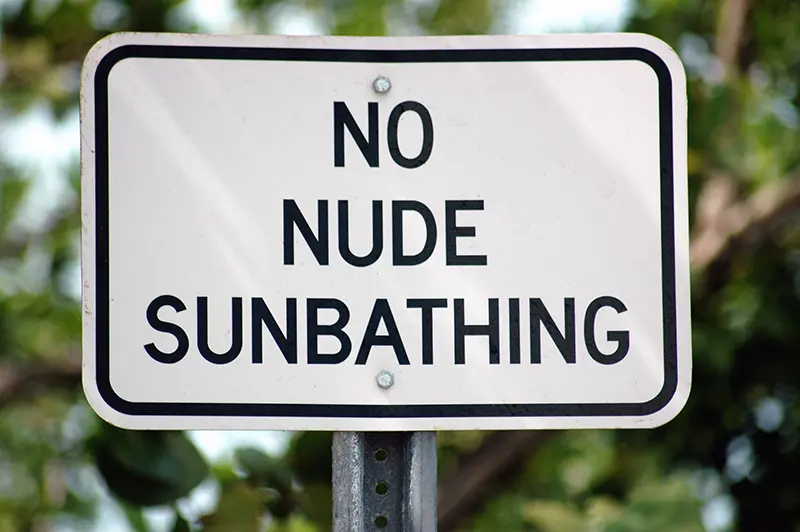
Thailand is conservative about public modesty. Section 388 of the Thai Criminal Code states that “whoever does any shameful act in public by indecently exposing himself, or by committing other indecent acts, shall be fined not more than 5,000 baht”. The law applies to all genders and covers topless or nude sunbathing, public nudity in clubs or on streets and any sexually explicit acts. Western blogs advise that topless sunbathing, particularly in predominantly Muslim southern provinces, is considered disrespectful; enforcement is sporadic but fines of up to 5,000 baht (≈£115) and deportation are possible. In 2016 two European tourists were fined for driving through Bangkok topless, and Thai celebrities have been prosecuted for public nudity. The bottom line: keep swimwear on at the beach and cover up away from the sand.
When to Visit Thailand: Seasons and Climate
Thailand’s weather is governed by two monsoon systems. The Andaman Sea & Eastern Gulf coast (Phuket, Krabi, Phang Nga, Trang and Pattaya) enjoys its driest weather from November to May, with clear skies, calm seas and temperatures around 28–32 °C. June–October brings monsoon rains and rough seas. The Gulf islands (Koh Samui, Koh Tao and Koh Phangan) have a slightly different pattern: their best season runs January to September, while October–December brings heavy showers. A shoulder season in March–May offers lower prices across the country but humidity is high. Northern Thailand (Chiang Mai, Pai) has cool, dry weather from November to February and a smoky burning season in March–April.
Best Places to Visit in Thailand
Cities and culture
Bangkok
Thailand’s thrilling capital is all glittering temples, river views, rooftop bars and some of the best street food on earth. Think the Grand Palace, Wat Pho, Wat Arun, Chatuchak and easy side trips to Ayutthaya or Kanchanaburi.
Daily budget: around ฿1,500–2,000 per day, roughly £34–46.
Best time to visit: November to February for cooler weather.
Chiang Mai
Calmer, greener and more soulful than Bangkok, Chiang Mai is the place for ancient temples, lantern festivals, mountain air and northern Thai culture. It also works beautifully as a base for Doi Inthanon, Chiang Rai and Pai.
Daily budget: around ฿2,500–3,500, or roughly £58–81.
Best time to visit: November to February. Avoid March to April if possible, when smoky air from seasonal burning can affect the city.
Ayutthaya
If you want Siamese grandeur without the modern chaos, Ayutthaya delivers temple ruins, riverside markets and some of the country’s most photogenic historical sites. It makes a superb cultural break from Bangkok.
Daily budget: about ฿1,000–1,500, roughly £23–35.
Best time to visit: year-round, though early mornings and late afternoons are far more comfortable in the heat.
Kanchanaburi
A place of moving history and softer scenery, Kanchanaburi blends the Bridge on the River Kwai, wartime memorials, caves, riverside stays and trips to Erawan Falls. It is one of Thailand’s most rewarding inland detours.
Daily budget: backpackers can manage on around ฿1,000 a day, with mid-range comfort at ฿2,500–3,500 and luxury generally below ฿5,000.
Best time to visit: November to March for cooler conditions.
Islands, beaches and natural wonders
Phuket
Phuket is Thailand’s glossy beach all-rounder: lively enough for nightlife lovers, polished enough for resort travellers, and broad enough to hide quieter corners away from the crowds. Beyond Patong, there is Old Phuket Town, island-hopping, beach clubs, temples and handsome beaches such as Surin and Nai Harn.
Daily budget: budget travellers should expect around ฿1,800–2,500 (£42–58), mid-range stays about ฿4,000–6,000 (£93–139), and luxury from ฿10,000+ (£231+).
Best time to visit: November to February.
Krabi
Krabi is postcard Thailand in full cinematic mode: limestone cliffs, emerald water, boat-only beaches and dramatic sunsets. Railay remains one of the country’s most iconic coastal escapes, while Phi Phi and Maya Bay bring the famous fantasy of The Beach into sharper, more carefully managed reality.
Daily budget: roughly ฿1,500–2,000 (£35–46) for budget travel, ฿3,000–5,000 (£69–116) mid-range, and ฿8,000+ (£185+) for luxury.
Best time to visit: November to April.
Koh Phangan
Yes, Koh Phangan is famous for the Full Moon Party, but that is only half the story. Away from Haad Rin, the island also offers waterfalls, yoga retreats, jungle roads and quieter northern beaches that feel far removed from the buckets and bassline.
Daily budget: around ฿1,500–2,000 (£35–46) for budget travellers, ฿3,000–4,000 (£69–93) mid-range, and ฿6,000+ (£139+) for luxury.
Best time to visit: January to September.
Koh Lipe
Koh Lipe is the sort of island that makes people extend their trip by a week and then quietly wonder about moving there. With white sand, clear water and easy snorkelling, it is one of Thailand’s most seductive southern islands.
Daily budget: expect ฿1,800–2,500 (£42–58) on a budget, ฿3,000–4,000 (£69–93) for mid-range comfort, and ฿7,000+ (£162+) for high-end stays.
Best time to visit: December to April. Bring cash, as ATMs can be limited and supplies pricier than on the mainland.
Pai
Pai is for backpackers who want mountains rather than beaches, and atmosphere rather than polish. Hot springs, bamboo rafting, easygoing cafés and a slightly bohemian mood make it a natural northern counterpoint to the islands.
Daily budget: around ฿800–1,200 (£18–28) budget, ฿2,000–2,500 (£46–58) mid-range, and ฿4,000+ (£93+) luxury.
Best time to visit: November to February.
Khao Sok National Park
For travellers who want jungle drama rather than beach glamour, Khao Sok is one of Thailand’s great escapes. Ancient rainforest, Cheow Lan Lake, floating bungalows and wildlife-rich treks make it one of the most memorable nature stops in the country.
Daily budget: around ฿1,200–1,800 (£28–42) on a budget, ฿3,000–5,000 (£69–116) mid-range, and ฿6,000–10,000+ (£139–231) for luxury floating camps and tented resorts.
Best time to visit: November to April.
Hidden gems & cultural side trips
- Koh Lanta (Andaman Sea) – laid‑back island with long beaches and minimal crowds.
- Sukhothai – 13th‑century ruins north of Ayutthaya; rent a bike to explore brick chedis.
- Isan region – ancient Khmer temples (Phanom Rung), Mekong river towns and silk villages; off‑the‑beaten‑track for adventurous backpackers.
Thailand Travel Costs and Accommodation
Backpacker, mid‑range and luxury budgets (nationwide)
Thailand appeals to every pocket. A backpacker’s daily budget of $30–50 covers a dorm bed, street‑food meals and local transport, equating to roughly £22–38 per day. Mid‑range travellers spending $60–120 per day enjoy private rooms, restaurant meals and occasional tours (≈£45–90). Luxury travellers can spend $150+ per day (≈£112+) on five‑star hotels and upscale experiences.
Accommodation costs reflect this range. Hostel dorms typically cost $5–15 (≈£4–11) per night, mid‑range hotels $25–70 (≈£19–52) and luxury resorts $100–400+ (≈£75–300+). Rural camping offers even cheaper options – for example, Khao Yai National Park charges 30 baht (≈£0.70) per adult to camp and rents tents for 150–225 baht (≈£3.50–5.20).
Cost breakdown for backpackers
For context, a 2026 backpacking budget table estimates:
- Dormitory bed: 400 baht (≈£9) per night
- Local restaurant meal: 250 baht (≈£5.60)
- Street food dish: 140 baht (≈£3.15)
- Long‑distance bus/train/ferry: 500 baht (≈£11.20)
- Local transport (tuk‑tuk/motorbike taxi): 100 baht (≈£2.25)
- Small beer: 80 baht (≈£1.80)
This yields a daily budget around 1,810 baht (£40) and a monthly cost around 45,728 baht (£1,020) per person. Digital nomads spending 35,000–65,000 baht per month (≈£810–£1,500) enjoy comfortable apartments, coworking spaces and social activities.
Natural hazards & what to watch for
Sharks and marine stingers
Shark attacks are extremely rare in Thailand. A TravelMole report notes that a single German tourist suffered a leg wound from a suspected bull shark at Phang Nga in December 2024; such incidents are so uncommon that local authorities issued warnings and red flags. No beach is consistently flagged for shark danger and most bites occur near fishing areas at dawn or dusk. Box jellyfish pose a greater threat in the Gulf of Thailand. A scientific review of surveillance data from 1997–2015 recorded 15 severe stings, of which six were fatal; most cases occurred on Koh Samui and Koh Phangan between July and October. Vinegar stations and netted swimming areas are installed on many beaches. Wear protective rash‑guards, avoid swimming during storms, and heed local warnings.
Snakes, spiders and crocodiles
About 15 % of Thailand’s snake species are venomous. Snakebites occur mainly among rural farmers; tourists rarely encounter snakes and the survival rate is nearly 100 % with prompt medical care. Wear closed shoes on jungle treks and watch where you step. Dangerous spiders are very rare; bites are seldom serious. Saltwater crocodiles have been virtually extirpated from mainland Thailand – the CrocAttack database lists only two non‑fatal crocodile attacks in the country between 2015 and 2024. Standard precautions (do not swim in rivers at night, heed warning signs) suffice.
Stray animals and rabies
Bangkok alone has an estimated 100,000 stray dogs, and the national stray population may exceed 730,000 animals. The city is introducing mandatory microchipping and sterilisation to control numbers. Dog meat consumption is illegal since 2014, though a small underground trade persists. Avoid petting strays and seek medical attention immediately if bitten – rabies vaccinations are widely available.
Other hazards
- Methanol poisoning: The FCDO reports deaths and serious illness from illicit spirits. Avoid cocktails or buckets served in low‑quality bars and stick to sealed bottles.
- Drug laws: Possessing even small amounts of illegal substances can lead to heavy fines or long prison terms; trafficking carries the death penalty. Cannabis remains illegal for recreational use. Police corruption and bribery exist; do not attempt to buy yourself out of trouble.
- E‑cigarettes and vaping: Vaping is illegal and can result in fines or jail.
- Political sensitivity: Criticising the Thai monarchy (lese majeste) is punishable by long prison sentences. Avoid political conversations in public or online.
Recommendations for lone female travellers
- Start in safer hubs: Chiang Mai, Pai and the Gulf islands (Koh Tao, Koh Lipe) have relaxed atmospheres and large backpacker communities. Use them to acclimatise before venturing to busier Bangkok or party islands.
- Choose reputable accommodation: Read recent reviews, choose hostels with lockers and 24‑hour reception, and avoid isolated guesthouses. In rural areas, homestays often offer safer and more authentic experiences.
- Stay connected: Purchase a Thai SIM card; apps like Grab (taxis), Bolt or 7/11 top‑ups are invaluable. Share your itinerary with friends or family and check in regularly.
- Respect local customs: Dress modestly, especially outside tourist zones. Avoid showing affection in public and never criticise the royal family. Learn a few Thai phrases – “khob khun ka/krub” (thank you) goes a long way.
- Keep copies of documents: Carry photocopies of your passport and visa; store digital copies securely online. Have comprehensive travel insurance covering medical care, theft and cancellation.
Thailand at a Glance
Best for: beaches, island hopping, culture, backpacking, luxury-for-less
Best time for Phuket/Krabi: November to April
Best time for Koh Samui/Koh Phangan: January to September
Solo female travel: generally manageable with sensible precautions
Topless sunbathing: not advisable and can get you into trouble
Budget: possible on a backpacker budget, but islands cost more
Biggest tourist mistakes: nightlife overconfidence, drink spiking risk, ignoring local laws, visa overstays
Thailand Beyond the Fantasy
Thailand can be a dream for solo female backpackers – azure waters, golden temples and jungle waterfalls offer a feast for the senses. Yet this paradise comes with caveats: you need street‑smarts, cultural sensitivity and respect for strict laws. Violent crime is rare but sexual assault and drink‑spiking do happen; the sex industry and corruption remain part of the landscape, and drug laws are uncompromising. Natural dangers such as jellyfish stings or snakebites are statistically remote. Provided you stay aware, budget realistically, follow local customs and choose the right season, the Land of Smiles will reward you with sun‑drenched beaches, rich cultural encounters and a sense of freedom that’s priceless.