If Al Capone Took the White House
An experiment in political imagination — we used AI to carry out an uncomfortable study of what happens when criminal instinct meets presidential power.
By Brendan Bishop
The Man Behind the Myth
Before we consider what would happen if If Al Capone Took the White House, we need to look at the man himself. Al Capone, popularly known as Scarface, was not simply a gangster in a fedora. He was a businessman of vice, violence and publicity.
Born in Brooklyn in 1899, Capone rose from New York street crime into the orbit of Johnny Torrio, moved to Chicago, and became the most famous criminal boss of the Prohibition era. His empire was built on bootlegging, gambling, prostitution, extortion, protection rackets and political corruption. But the crucial point is not just what he sold. It is how he operated.
Capone understood organisation. His criminal world was not a chaotic street gang, but a structured business machine: delegated, protected, branded and politically insulated. He bought influence, frightened witnesses, rewarded loyalty and wrapped criminal profits in the appearance of normal enterprise. By the mid-1920s, he had become not merely an underworld figure, but a celebrity.
He hated the nickname Scarface, tried to keep the scarred side of his face out of photographs, and even claimed the wounds were war injuries. Some biographical accounts add that he used face powder to soften or conceal their appearance.
But the scars that later gave Capone his nickname came not from war, but from his own ugly behaviour towards a woman. While working at Frankie Yale’s Harvard Inn in Coney Island — variously described as bartender, bouncer and muscle — Capone made a crude advance towards a female patron and reportedly kept bothering her after she rebuffed him. Her brother, Frank Galluccio, retaliated by slashing Capone across the face with a knife.
He also understood something many more respectable men never fully grasp: fear alone is bad politics. Capone cultivated legitimacy. He gave interviews, dressed well, donated to charity, opened a soup kitchen during the Depression, and presented himself as a benefactor of the common man even while his fortune came from intimidation and vice. The FBI’s historical account records that Capone was eventually brought down through tax evasion rather than the wider violence and racketeering associated with his name. He was sentenced to federal prison and, after release, lived in seclusion with his family on Palm Island, Florida, until his death in 1947.
That is where this thought experiment begins.
Not with the caricature of Capone, but with the real pattern: money, spectacle, intimidation, political protection, public generosity and private ruthlessness.
The Premise: Capone Reborn in Modern America
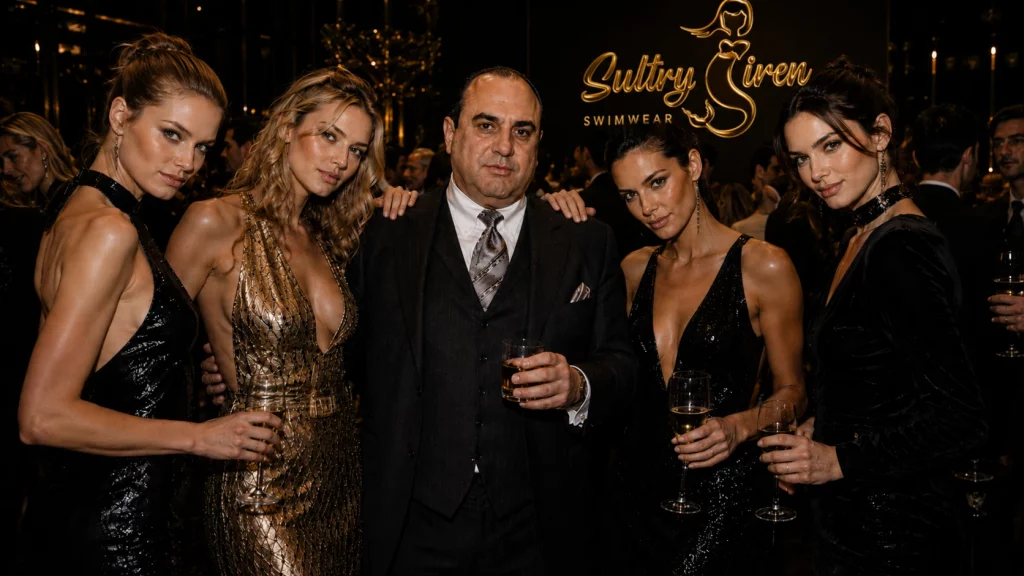
For the first part of the experiment, we asked ChatGPT to imagine that Al Capone was alive today, and that he had been born in Brooklyn, as in real life, but in 1959 instead of 1899. What would his business ventures look like?
The answer was almost inevitable:
Prohibition never gives him his great opening, because alcohol is legal. So the modern Capone builds a different kind of empire: real estate, hospitality, nightlife, prostitution, gambling, construction, logistics, ports, security, offshore companies, crypto, shell corporations and Florida property.
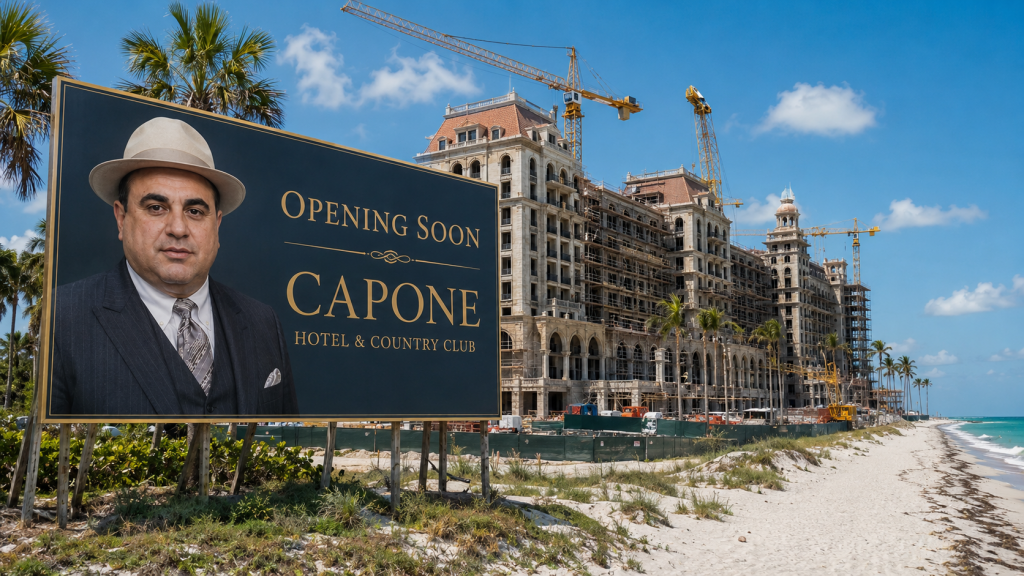
He is still the same type of man, but the tools have changed. Instead of breweries and speakeasies, he has hotel groups, casino ventures, private clubs, construction firms, port contracts, event spaces, logistics companies, adult-entertainment interests, offshore accounts and layers of lawyers. In public, he is a developer and philanthropist. In private, he is a tollbooth.
And because Capone already understood that power needs an audience, he would not stop at newspapers. The historical Capone gave interviews freely, held press conferences and enjoyed the spotlight; a modern Capone would take naturally to television. He would cultivate the image of a charismatic, hard-nosed celebrity tycoon through controlled sit-down interviews, glossy profiles of his resorts and clubs, charity appearances, boxing nights, golf events, casino openings and carefully staged access to his Florida mansion. He would know how to turn notoriety into entertainment — and entertainment into legitimacy.
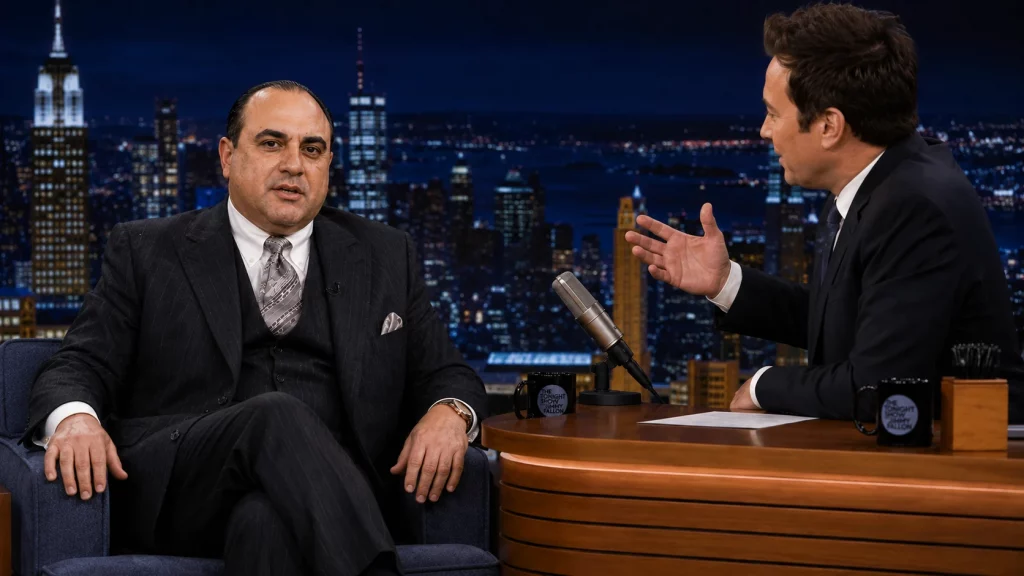
Then came the second part of the experiment, in which we proposed the following scenario:
After serving a short sentence for tax evasion, Capone moves back to his Florida mansion and carries on. But the authorities are closing in again. Then he sees the opening.
If the presidency can delay prosecution, complicate investigations, shield official acts, control federal law enforcement and reshape public attention, why run from the law when he can run the country? The Justice Department has long maintained that indicting or criminally prosecuting a sitting president would undermine the executive branch’s ability to function, while the Supreme Court’s 2024 immunity ruling gave presidents broad protection for official acts, though not for purely private conduct.
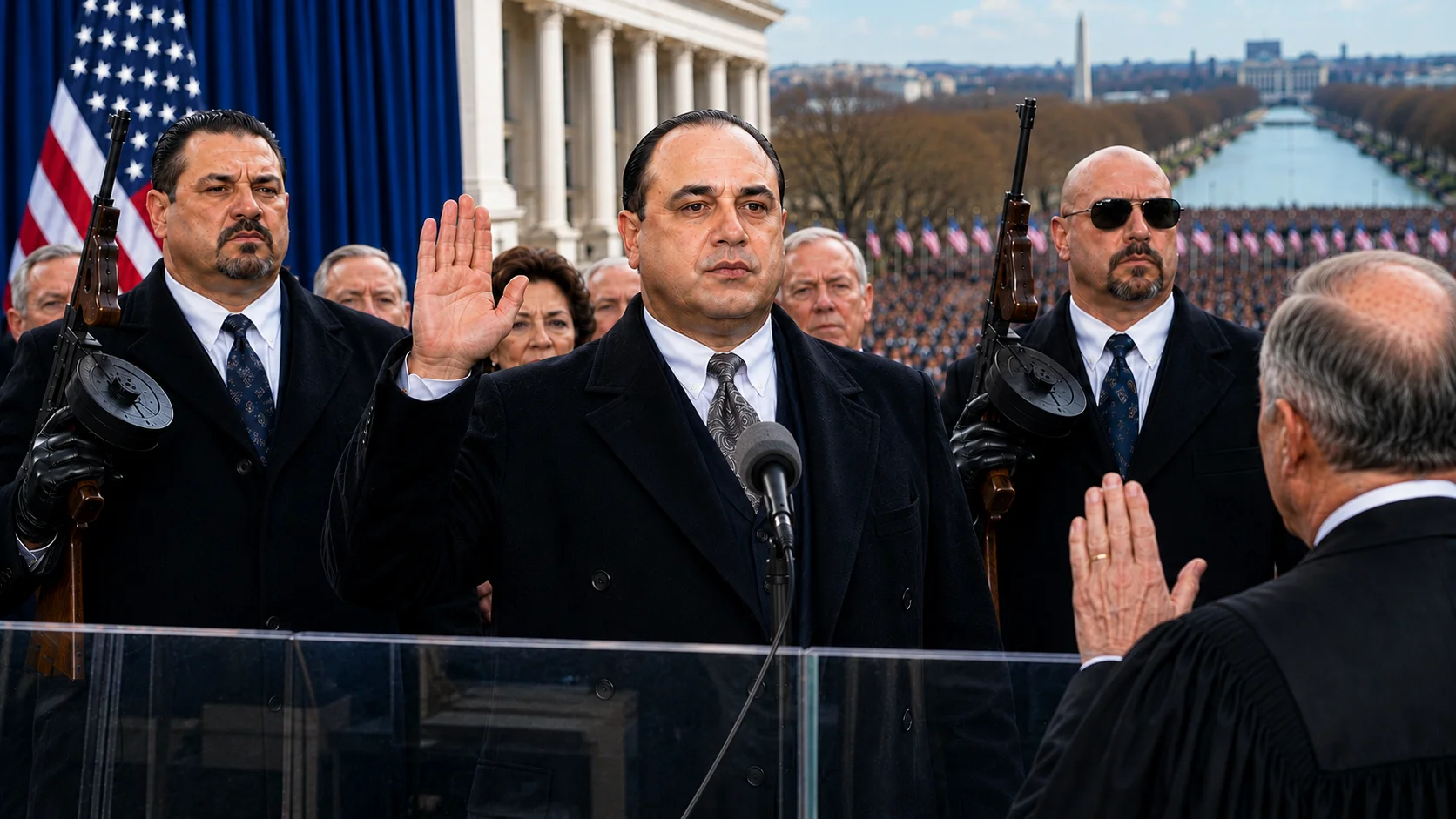
So Capone runs. And wins. Not narrowly, but decisively. In this scenario, his victory brings with it total control of the Senate and the House of Representatives, leaving him with the White House, Congress and the machinery of federal power all moving in the same direction.
We asked the system to use all we know about Al Capone and imagine what a presidency under Scarface would look like.
The response was chilling.
The Campaign: The Boss Becomes the Candidate
A President Capone campaign would not begin with policy. It would begin with grievance.
He would not say, “I am innocent” in the ordinary legal sense. He would say, “They are only prosecuting me because I know how rotten the system is.” Every indictment would become a badge of honour. Every prosecutor would become corrupt. Every judge would become compromised. Every journalist would become part of the conspiracy.
His genius would be turning criminal exposure into political theatre.
The campaign would be staged like a rolling television drama: construction sites, boxing gyms, charity kitchens, police backdrops, churches, veterans’ halls, racetracks, golf courses and Florida resorts. He would appear in hard hats and tailored suits. He would talk about “respect”, “order”, “strength”, “loyalty” and “getting things done”. He would not hide the gold, the cars, the planes or the mansions. He would sell them as proof that he knew how to win.
The slogans would be simple, brutal and emotionally satisfying:
Take Back the Streets.
Order. Jobs. Respect.
The Boss Gets It Done.
They Fear Him Because He Can’t Be Bought.
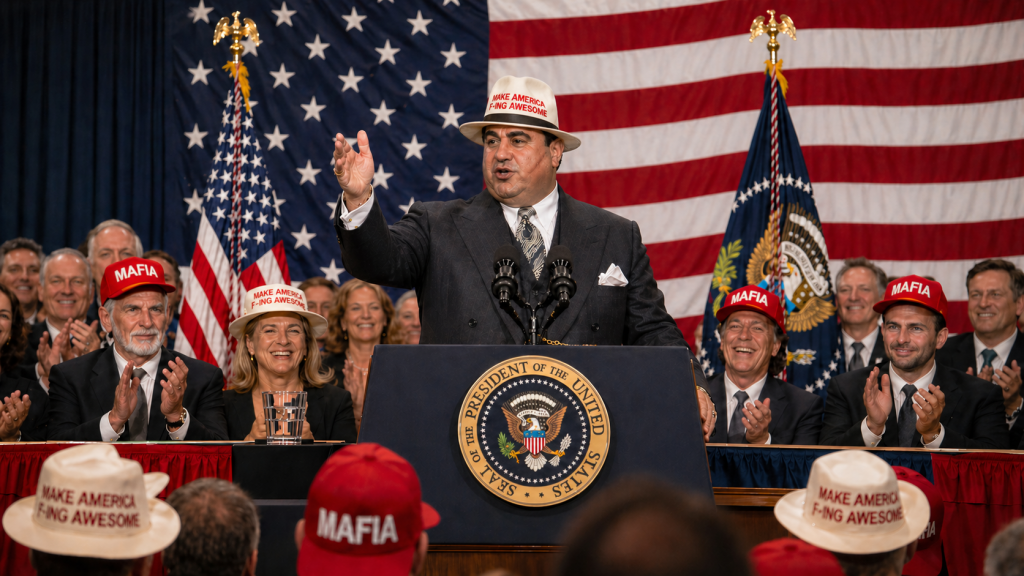
That last line would be the trick, of course. Capone would already be compromised by the world around him — but he would present corruption as independence. The pitch would be that polished politicians had sold the country out, while he was rich enough, tough enough and dirty enough to beat the dirty system at its own game.
Financially, the campaign would be sophisticated. Under U.S. campaign rules, candidates can spend unlimited amounts of their own money, while direct contributions to campaigns are limited; super PACs, however, can accept unlimited contributions for independent spending.
A modern Capone would exploit every inch of that system. His official campaign would remain lawyered and technically compliant. Outside it would sit a constellation of super PACs, friendly nonprofits, trade groups, consultants, media companies, shell-linked donors, property investors, gaming interests, crypto promoters and “law-and-order” organisations. The money would not need to arrive in bags left in alleyways. Lawful opacity, stretched to its limit, can begin to resemble laundering in a suit.
He would also use his criminal cases as fundraising fuel. Court dates would become rallies. Search warrants would become merchandise. Mugshots would become icons. Legal danger would be converted into brand loyalty.
Election Night: The Protection Racket Goes National
Once Capone wins, the presidency becomes something no historical crime boss ever possessed: direct influence over federal prosecution, appointments, intelligence priorities, sanctions, tariffs, procurement, pardons and the national story.
His first instinct would not be ideological. It would be defensive.
Capone would understand that his survival depends on controlling the machinery that might otherwise destroy him. The old Capone needed bribed police, friendly judges and frightened witnesses. President Capone would need something bigger: a captured executive branch.
The First Hundred Days: Emergency as a Weapon
He would begin by declaring a sweeping national emergency at the southern border, presenting migration, trafficking and organised crime as an invasion demanding extraordinary presidential power. That emergency would become a skeleton key: troop deployments, aggressive federal raids, vast detention and security contracts, fast-tracked procurement, loyalty tests inside law enforcement and a permanent television spectacle of force. From there, the same language of crisis and “strategic necessity” could be extended outward — to shipping lanes, canals, neighbouring territories or any foreign pressure point he wished to turn into leverage.
Alongside it would come an anti-cartel initiative, an anti-corruption drive, a domestic crime crackdown and a sweeping programme to rebuild American infrastructure. The language would sound patriotic. The structure underneath would be pure racketeering.
The point would be to create a constant sense of emergency. Emergency allows speed. Speed weakens scrutiny. Weak scrutiny creates room for loyal appointments, rushed contracts, selective prosecutions and money flows that are difficult to challenge before they become facts on the ground.
Capone would not abolish institutions overnight. That would be crude. He would capture chokepoints.
The Department of Justice would be the first prize. The FBI would be the second. Treasury, Homeland Security, Commerce, the IRS, sanctions offices, procurement agencies and intelligence channels would follow. He would not need every civil servant to be loyal. He would need the people who control priorities, approvals, access, investigations, public messaging and internal paper trails.
The Cabinet: Lawyers, Fixers and Respectable Front Men
A normal president chooses a cabinet to govern. Capone would choose one to protect, enrich and intimidate.
His Attorney General would be the most important appointment in government: a respectable-looking legal operator with an expansive view of executive power and no sentimental attachment to prosecutorial independence. This person would not necessarily announce that investigations into Capone were dead. That would be too obvious. Instead, cases would be reviewed, delayed, reassigned, narrowed, deprioritised, procedurally challenged or buried beneath “urgent national priorities”.
The Attorney General would become the firewall.
The Attorney General: Shield and Blade
The Attorney General would not merely protect Capone from prosecution. He would also give Capone something every gangster wants but few ever obtain: the power to prosecute his enemies.
This would not usually begin with fabricated charges. That would be too risky, too crude and too easy for honest prosecutors to resist. Capone would prefer something more sophisticated: selective justice. Find a rival’s tax irregularity, a donor’s foreign payment, a hostile governor’s campaign-finance mistake, a prosecutor’s old email, a journalist’s source, a business competitor’s licensing issue — then turn it into a federal investigation.
The punishment would not need to be conviction. The investigation itself would be enough. Legal bills. Seized phones. Frozen accounts. Terrified donors. Headlines about “possible corruption”. Years of uncertainty. The message would be unmistakable: oppose the boss and the state will find something.
The Attorney General would therefore become both shield and blade. Shield, by slowing or smothering cases that threaten Capone, his family or his businesses. Blade, by opening cases against politicians, prosecutors, journalists, former associates and business rivals who refuse to bend.
If desperate, Capone might go further: pressured witnesses, exaggerated charges, coached informants, selective leaks or evidence stretched beyond recognition. But the more realistic danger is subtler. He would not need to invent every crime. He would take the ordinary discretion of law enforcement and apply it with criminal selectivity.
In Capone’s America, justice would not be blind. It would know exactly who the boss was.
The Treasury Secretary would need to understand money, but not too honestly. Ideally, this would be someone from finance, real estate, gaming, crypto or private equity: someone who speaks the language of markets while quietly knowing how wealth disappears into complex structures.
Commerce would go to a dealmaker. Labour would go to someone who can talk to unions without threatening racketeering networks. Homeland Security would go to an emergency-politics hardliner who sees border security, detention, surveillance and procurement as one vast operating system. The CIA would go to someone comfortable with transactional foreign relationships and deniable channels. The FBI would go to a loyalist or an outsider whose lack of institutional attachment is precisely the point.
Family would not necessarily occupy every official title, because that invites ridicule. But family would sit close to the money: foundations, private investment vehicles, media ventures, crypto projects, foreign licensing deals and “independent” business entities that always seem to benefit from government direction.
The Senate confirmation process would still matter in real life, because principal officers are generally nominated by the president and confirmed with the advice and consent of the Senate. But in this premise, Capone has strong control of Congress, meaning the confirmation machinery becomes less of a check and more of a loyalty ritual.
The Press Secretary: A Political Attack Dog in a Polished Suit
Capone would not want a traditional White House press secretary.
He would want a performer.
The job would require someone attractive to television, fluent in outrage, fast with insults, legally cautious when necessary, and shameless enough to turn every question into an attack on the person asking it. The press secretary would not explain policy so much as enforce reality.
A question about corruption would become an attack on “the old establishment”. A question about Capone’s court cases would become “disinformation”. A question about foreign payments would become “hatred of American success”. A question about pardons would become “why do you hate second chances?” A question about prostitution, trafficking or compromising files would become an accusation against the media, celebrities, prosecutors or political enemies.
In Capone’s White House, the press briefing room would not be a window into government. It would be a boxing ring.
He would choose a fiercely loyal, camera-savvy, legally cautious and media-combative press secretary — not a neutral explainer, but a polished political brawler whose real job is to protect him, attack the press and prevent scandal from settling into a clean narrative.
Pardons: Loyalty as Currency
The pardon power would become one of Capone’s favourite instruments.
The U.S. Constitution gives the president broad clemency power for federal offences, though it does not cover state crimes or impeachment.
Capone would read that not as mercy, but as leverage.
Useful criminals would understand the bargain. Stay quiet, absorb damage, protect the boss, and one day the White House may make the problem go away. A corrupt union fixer, a convicted fraudster, a violent campaign supporter, a loyal money launderer, an old tax associate, a witness who refused to co-operate — all would know that loyalty could be rewarded.
Some pardoned figures would be brought back into politics through advisory boards, ambassadorships, task forces, government-adjacent foundations, security contracts or media platforms. Others would simply become living warnings: betray him and you are alone; serve him and even prison may not be the end.
The most dangerous effect would not be the pardon itself. It would be the lesson it teaches: the law is negotiable if the boss owes you.
Law and Order, Capone-Style
Capone would absolutely campaign as a law-and-order president.
But his definition of crime would be territorial, not moral.
Street crime would be punished hard because it is visible, frightening and politically useful. Shoplifting, gang shootings, migrant crime, fentanyl deaths, riots, carjackings and urban disorder would dominate his speeches. Police would be praised. Federal task forces would be announced. Cameras would be invited to raids.
But useful crime would be treated differently.
Bid-rigging, shell-company abuse, intimidation of witnesses, friendly tax evasion, offshore money, procurement fraud, regulatory favours, bribery disguised as investment, and politically protected vice would be ignored, redirected or legalised through loopholes. Capone would not be against crime. He would be against crime he does not control.
That distinction is the heart of the whole presidency.
Tariffs: The Protection Racket as Trade Policy
A normal tariff is a trade instrument. In Capone’s hands, it would become a protection racket.
Foreign governments would learn the language quickly. Buy into the right project, receive relief. Challenge him, face tariffs. Criticise him, face inspections. Refuse to do business with his circle, face “national security” restrictions. Support his international agenda, receive exemptions.
The same logic would apply to corporations. A multinational refusing to invest in Capone-linked projects might suddenly discover regulatory problems. A company that moves production through a friendly Capone logistics network might receive better treatment. A foreign steelmaker, car company, pharmaceutical firm, casino operator or port investor would not merely ask, “What is U.S. policy?” It would ask, “Who do we need to please?”
This is where Capone’s gangster instinct would fit modern presidential power almost perfectly. A protection racket says: pay me and nothing bad happens. Tariff politics, corrupted, can say the same thing at national scale.
Sanctions: Punishment, Profit and Personal Power
Sanctions would become another private weapon.
Officially, Capone would use them against corruption, trafficking, hostile regimes, terrorism and national-security threats. Unofficially, sanctions and sanctions relief would become bargaining chips.
A foreign oligarch who invests in the wrong American project might be sanctioned. A government that grants a Capone-linked company a casino licence, port concession, hotel deal or mineral contract might find sanctions quietly delayed. A rival business empire could be hit with asset freezes. A friendly state could be rewarded with exemptions.
Capone would particularly love the ambiguity. Sanctions sound moral. They can be justified in the language of human rights, drugs, terrorism, corruption or national security. But they also move money, destroy competitors, create scarcity and make access to Washington immensely valuable.
A gangster president would recognise that immediately.
CapoCoin: The Digital Racket
Then comes CapoCoin.

Capone’s historical problem was always money: how to hide it, wash it, move it and spend it without leaving enough evidence to convict him. A modern Capone would see crypto not as a novelty, but as an opportunity.
CapoCoin would be marketed as patriotic financial freedom: a new American digital asset for people tired of banks, elites and globalists. It would be wrapped in slogans about independence, privacy, innovation and the forgotten worker. Supporters would buy it as a badge of loyalty. Speculators would buy it because anything attached to the president might soar. Foreign actors would buy it because it creates a deniable way to place money near power.
The real structure would be more sinister.
Capone-linked insiders would hold large early stakes. Friendly exchanges would promote it. Regulators would go soft. Competing coins would face scrutiny. Government contractors might be encouraged, then required, to accept payment through Capone-approved wallets. Welfare pilots, veterans’ benefits, border contracts or disaster-relief schemes might test it as “efficient digital delivery”. The coin would become not merely a financial product, but a loyalty network.
CapoCoin could become a state-sanctioned laundering and patronage system, with federal agencies paying contractors through approved wallets, off-the-books money moving through token structures, and supporters rewarded while opponents find themselves frozen out.
That is speculative, but the instinct is realistic. Capone would love a currency that is both brand, bank, bribe and database.
Insider Trading: The Race-Track Tip Becomes Policy
Capone was a man of gambling, odds and advance knowledge. As president, he would possess the most valuable tip sheet in the world.
He would know before the public when tariffs were coming, when sanctions were lifting, when oil policy was changing, when a defence contract was about to land, when a port restriction was coming, when a crypto rule would be softened, when a prosecution would be announced, when a merger would be blocked, or when military action might shake markets.
That knowledge is tradable.
The SEC’s investor guidance treats insider trading as including government employees who trade on confidential information learned through their employment, and political-intelligence consultants who may tip or trade based on material, non-public information obtained from government employees.
Capone would not sit in the Oval Office buying oil futures under his own name. He would use family offices, trusted friends, offshore vehicles, friendly funds, business partners, lawyers, accountants and shell companies. His circle could trade before tariffs, sanctions, oil decisions, defence contracts, gambling deregulation, cannabis rules, crypto announcements or emergency declarations.
This would be the modern equivalent of knowing the race result before the betting window closes.
The presidency would give Capone something more valuable than bootlegging routes or casino skim: advance knowledge of market shocks.
Government Contracts: The National Skim
No Capone presidency would be complete without contracts.
He would not normally say, “Give this deal to my friend.” He would not need to. Federal procurement rules generally require full and open competition, but the Federal Acquisition Regulation contains exceptions, including urgency and circumstances where delay could seriously injure the government.
That is where the opportunity lies.
Capone would manufacture urgency. Border crisis. Port crisis. Cyber crisis. Drug crisis. Housing crisis. Infrastructure crisis. Shipping crisis. Energy crisis. Every crisis would justify speed. Every speed exception would weaken competition. Every weakened competition would favour the people already waiting in the room.
The visible winner might be a respectable prime contractor. The real profit would sit underneath: subcontractors, consultants, logistics firms, security companies, property leases, data vendors, construction suppliers, licensing fees, inflated valuations and politically connected local partners.
The President would not need to own the winning company. He would only need a tollbooth somewhere in the chain.
Foreign Policy: The Cartel of Strongmen
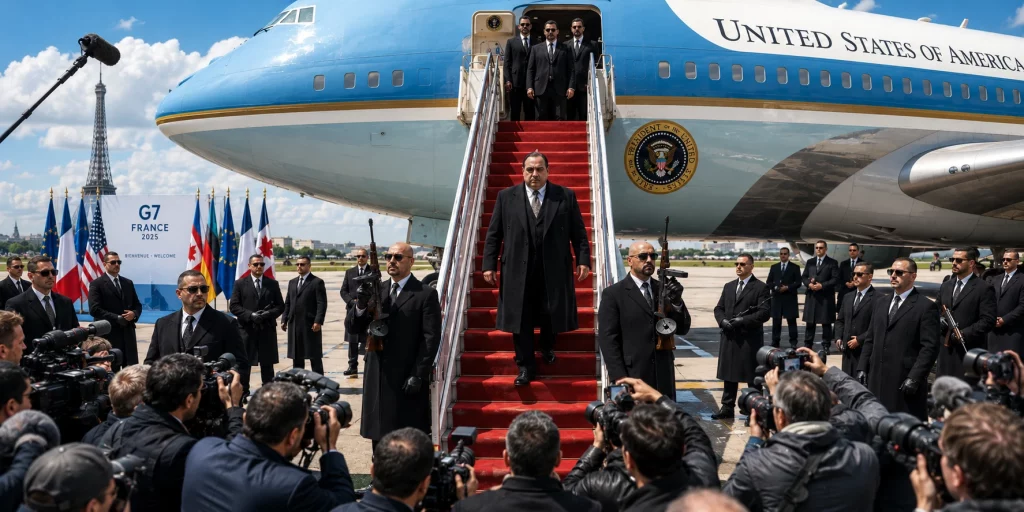
Capone would not approach foreign policy as diplomacy. He would approach it as territory.
Allies would become clients. Enemies would become opportunities. Institutions would become obstacles. NATO, the UN, the G7, the EU, international courts, anti-corruption bodies and human-rights organisations would all irritate him because they claim authority above the boss.
His attitude would be simple: pay, flatter, obey or get punished.
He would threaten NATO funding. He would mock international courts. He would treat the UN as a nuisance. He would accuse human-rights organisations of corruption. He would say anti-corruption bodies were political weapons. He would prefer leaders who understand personal deals: strongmen, oligarchs, monarchs, presidents-for-life and cartel-adjacent governments willing to trade silence for access.
Over time, he might not literally create a “League of Nations” for criminals, but he would create something close in spirit: a loose cartel of strongmen who agree not to ask awkward questions about each other’s money, elections, prisons, mistresses, offshore accounts, security services or dead opponents.
Blackmail, Censorship and the Art of Moral Fog
Every Capone presidency would eventually face a scandal it could not easily bury.
In this scenario, imagine something like the Epstein files: a vast archive of names, flights, parties, properties, victims, fixers, photographs, financial links and unanswered questions. Given Capone’s imagined modern world — New York, Florida, real estate, prostitution, nightlife, private clubs, wealthy men, offshore finance and powerful friends — it is not difficult to imagine why such a file would terrify him.
Could someone hold leverage over him?
Yes — but probably not an ordinary rival gangster. The actors most likely to hold compromising leverage over a president who dominates a domestic underworld are those shielded by institutional or sovereign protection: foreign intelligence services; federal or state prosecutors with cooperators and documentary records; major financial institutions and compliance departments holding suspicious-activity trails; or transnational networks with their own armed capacity and distance from U.S. retaliation.
The presidency would not make him invulnerable to such pressure. It would make the consequences larger. If a foreign service, offshore intermediary or sealed insider archive contained material that could implicate him financially or sexually, the result would not necessarily be resignation. More likely it would shape selective softness, overreaction, sudden foreign-policy stunts and erratic scandal choreography.
Full Disclosure
During the campaign, he promises full disclosure.
In office, he releases fragments.
The files are “under review”. Names are redacted for “national security”. Victim protection is invoked. Intelligence sources must be protected. Prosecutors need more time. Archivists are blamed. Then fired. Then replaced. Friendly media receive selective leaks. Enemies’ names appear first. Allies’ names disappear into black ink.
Each release raises more questions than it answers. That is the point.
Capone would not try to make the scandal vanish. He would make it impossible to follow. One day there would be a leak about an opposition senator. The next, a claim about a Hollywood actor. Then a lawsuit against a newspaper. Then an “anti-trafficking” task force. Then a dramatic arrest. Then an accusation that the real predators are hiding inside the media.
The method would be moral fog. If everyone looks filthy, nobody can see the boss clearly.
The Distraction Machine
Would Capone start a war to distract from scandal?
Not at first. He would begin with cheaper weapons: insults, leaks, lawsuits, threats, pardons, firings, raids, emergency declarations, celebrity smears, bot campaigns, AI-generated rumours and selective prosecutions.
If that failed, he would escalate.
A Caribbean or Venezuela operation would be tempting because it could be sold as anti-drug, anti-cartel, anti-trafficking, border security and hemispheric strength all at once. Panama would tempt him because the canal is symbolically powerful and economically vital. Mexico would be emotionally tempting but far more dangerous, because any conflict there would immediately rebound into migration, trade, supply chains and domestic politics. Iran would be the high-drama option: oil, ships, missiles, flags, presidential addresses and wall-to-wall coverage.
The escalation ladder is easy to imagine: smear first, disinformation second, emergency politics third, limited foreign crisis fourth, broader war only if survival demands it.
That feels right. Capone would not ask whether a crisis served the national interest. He would ask whether it changed the subject.
Rebranding the Republic
Capone would care deeply about legacy, because men like him confuse visibility with greatness.
He would leave a visual stamp everywhere. The Oval Office would become darker, heavier, richer and more theatrical: gold trim, polished wood, oversized furniture, heroic paintings, flags, family symbols and carefully chosen historical props. Presidents often alter the design of the Oval Office; a Capone presidency would take that custom and push it towards ownership.
Federal buildings would be renamed. Airports would be “restored” under his name. A national garden would include a suspiciously heroic statue. Bridges, ports, highways and redevelopment zones would carry Capone branding. His foundation would fund scholarships. His allies would produce documentaries. Friendly universities would establish leadership institutes. Children would be told he rebuilt American greatness.
A man who once understood the value of a soup-kitchen sign would understand the value of a skyline.
Years Two to Four: The Rot Becomes Normal
By the second year, the shock would fade.
That is when the danger deepens.
The Justice Department would no longer need to announce its loyalty; everyone would understand it. Contractors would know which consultants to hire. Foreign governments would know which hotels to use, which foundations to flatter and which family ventures to support. Prosecutors would know which cases are career-ending. Regulators would know which industries are protected. Journalists would know which questions trigger retaliation. Allies would know that treaties are negotiable. Enemies would know that flattery works.
The country would still have elections, courts, hearings, press conferences, patriotic ceremonies and constitutional language. But underneath, the operating principle would have changed.
Public office would become a franchise. Politically, if not economically, the United States would have become a banana republic in the modern sense of the phrase: a country where constitutional forms still exist, but power is increasingly personal, institutions are bent around the ruler, loyalty outranks law, and public office becomes a mechanism for private reward and political punishment.
If He Lost
If Capone lost re-election, he would not simply concede.
He would claim fraud. He would pressure state officials. He would demand investigations. He would suggest foreign interference. He would urge supporters to “protect the victory”. He would file lawsuits not necessarily to win, but to delay. He would seek emergency rulings. He would hint that unrest was possible. He would bargain privately for immunity.
If forced out, he would try to preserve three things: his money, his family and his silence network.
The final weeks would be the most dangerous, because that is when the presidency stops being a prize and becomes a bunker.
Roy Cohn: The Real-Life Ghost in the Capone Scenario
There is one real-world detail that makes the imagined Capone presidency feel even less fantastical.
Donald Trump’s most important early mentor was Roy Cohn: the ruthless New York lawyer, political fixer and former McCarthy aide who represented Trump from 1973 through the mid-1980s. Cohn first entered Trump’s life during the federal racial-discrimination case against the Trump family’s housing business, advising an aggressive counterattack rather than conciliation. From there, he became far more than a lawyer. He was a tutor in combat: deny, attack, countersue, never apologise, and treat bad publicity as useful publicity.
Cohn’s other clients are what make the connection so striking. He represented major organised-crime figures, including Anthony “Fat Tony” Salerno and John Gotti; multiple accounts also place Carmine Galante and Paul Castellano among the mob figures he represented or advised. The Marshall Project reported that Salerno and Castellano were regular visitors to Cohn’s East 68th Street townhouse during the years when Cohn was mentoring Trump through the brutal world of New York real estate.
What matters is not a formal label. It is the apprenticeship. Trump’s early political and legal education came from a lawyer whose world overlapped with New York property, tabloid warfare, political intimidation and the defence of major Mafia figures. Cohn taught a style of power built on attack, denial, counterattack and the conversion of law into a weapon. In the Capone thought experiment, that matters enormously. The imagined president who wants an Attorney General as both shield and blade does not feel purely fictional. He feels like an extreme version of a political culture that already exists in plain sight.
The Trump Echo
The point is not to make a literal legal claim of organised-crime membership. It is to ask what happens when the imagined habits of a modern Capone — loyalty above law, spectacle above truth, private enrichment through public office, pardons as political currency, prosecutors treated as weapons, allies treated as customers and enemies treated as targets — are placed beside the documented conduct of Donald Trump.
The resemblance is not exact. It is more unsettling than that. It is structural.
Trump became the first U.S. president to take office with a felony criminal conviction after receiving an unconditional discharge in January 2025. He has been held civilly liable for sexually abusing E. Jean Carroll and defaming her, with jury awards totalling $88.3 million.
Then there was Trump University: a Trump-branded real-estate seminar business that ended in fraud lawsuits from former students who said they had been drawn in by false promises and pressured into paying up to $35,000. Trump agreed to a $25 million settlement in 2016, while denying wrongdoing and admitting no liability; New York’s attorney general hailed the deal as a victory for the victims of his “fraudulent university”.
Trump’s conflict with the tax authorities then acquired an almost absurdly apt resonance for this thought experiment. In January 2026, Trump, his two eldest sons and the Trump Organization sued the IRS and Treasury Department for at least $10 billion over the unlawful leak of their confidential tax returns during his first term. The claim is not, strictly speaking, defamation; it is that the agencies failed to prevent a former IRS contractor from disclosing protected tax information.
Since this article was first published, the parallel has become still more extraordinary. In May 2026, the Justice Department added a provision to Trump’s IRS settlement “forever” barring the federal government from pursuing examinations or claims tied to tax returns filed before 18 May 2026 involving Trump, his family, his companies and affiliated entities.
The department says future tax returns are not covered. Even so, the optics are staggering: the president’s own Justice Department has helped secure a permanent shield against a category of past tax scrutiny for the president, his family and his business orbit.
The settlement carried another, still more brazen echo. As part of the same arrangement, the Justice Department created a $1.776 billion Anti-Weaponization Fund to compensate people who claim they were victims of government “weaponization”. Within days, Senate Republicans were in open revolt over the scheme, with Reuters reporting concern that the money could reach Trump allies and people convicted of violent crimes during the January 6 Capitol riot. Even by the standards of this thought experiment, that pushes the comparison into darker territory: not merely shielding the boss from scrutiny, but creating a taxpayer-funded mechanism that could reward the loyalists and foot soldiers around him.
For an article imagining what Al Capone might do with presidential power, it is almost too neat: the gangster famously brought down by the taxman is echoed by a president whose own administration has now helped fence the taxman away from his past returns.
Trump returned to office and granted clemency to almost all of the more than 1,500 January 6 defendants. His family’s crypto ventures have drawn conflict-of-interest scrutiny. His tariff announcements triggered questions over unusually well-timed market trades. His Justice Department has stepped back from anti-corruption enforcement and weakened public-integrity safeguards in ways critics say threaten law-enforcement independence.
And in 2026, Trump repeatedly threatened or considered pulling the United States out of NATO amid rising tensions with allies.
That is what makes the Capone experiment uncomfortable — and, since publication, still more so. The United States has not literally become a banana republic. But in the modern political sense — personal rule over institutional restraint, loyalists over independent officials, retribution over equal justice, and public power increasingly used for private and partisan ends — Donald Trump is pushing it alarmingly in that direction. What Capone would have built deliberately as a gangster president now feels disturbingly close to the political road America is already travelling.
Death Tallies
Al Capone is commonly estimated to have been responsible, directly or indirectly, for more than 200 killings, though the exact number can never be known with certainty.
There is no single honest “Trump death toll” that can accurately be given. Some decisions involve direct military action, where deaths can be counted. Others involve policy choices that researchers model as causing preventable deaths, but which are not recorded in a single official ledger. Still others involve omissions or diplomatic choices, where the human consequences may be immense but cannot responsibly be converted into a Trump-specific body count.
That said, two categories stand out.
If we count deaths tied very directly to U.S. military action during Trump’s second term, the strongest documented case is the 2026 U.S.-Israeli war on Iran — especially the Minab school strike, where 168 children were reported killed and U.S. military investigators said American forces were likely responsible, pending final conclusions.
Trump’s aid cuts cannot yet be assigned one universally accepted “confirmed death toll”, but serious public-health modelling has warned of devastating consequences. A Lancet-linked study estimated that deep USAID cuts could cause more than 14 million additional deaths by 2030 if they persist. Separate one-year modelling has projected very large near-term mortality from disrupted aid programmes.
The Strange Little Echoes
The larger comparison is political, not biographical. Yet the smaller echoes are hard to miss.
Both men were New Yorkers shaped by immigrant family stories: Capone the Brooklyn-born son of Italian arrivals, Trump the Queens-born son of a Scottish immigrant mother and grandson of a German immigrant. Both later made Florida part of their personal mythology — Capone at Palm Island, Trump at Mar-a-Lago. Both loved golf. Both cultivated an image of grandeur, excess and visual glitter. Capone dressed like a celebrity gangster; Trump gilded his properties and his politics.
Both understood the camera as an instrument of power. Capone stepped into the spotlight, held press conferences, and burnished his public benefactor image through gestures such as his Depression-era soup kitchen. Trump made politics inseparable from spectacle, turned court appearances into campaign theatre, and offered himself to supporters not merely as a candidate but as protector, avenger and saviour: “I am your warrior, I am your justice… I am your retribution.”
Both were willing to fictionalise themselves. Capone tried to pass off the scars on his face as war wounds, despite never having served. Trump’s falsehoods operated on a vastly larger industrial scale, with The Washington Post documenting more than 30,000 false or misleading claims during his first term. Even the scars themselves carry a nasty little echo: Capone received them after making a crude remark to a woman; Trump, when pressed by a female reporter about the Epstein files in 2025, snapped: “Quiet, quiet piggy.”
Then there are the money rhymes. Capone made a fortune from bootleg alcohol; Trump threatened 200% tariffs on European wine, cognac and spirits in a dispute over American whiskey. Capone survived through political protection and bribed influence; Trump’s second term has produced a shinier twenty-first-century equivalent in the optics of money seeking access — from $TRUMP coin buyers spending an estimated $148 million in pursuit of a dinner with the president to vast family crypto revenues drawing ethics warnings about foreign influence and pay-to-play politics.
And perhaps most tellingly, both men treated accountability as something to outmanoeuvre. Capone ultimately went down for tax evasion, not the crimes that made him infamous. Trump publicly called paying no income tax “smart”, used legal peril as campaign fuel, and has repeatedly converted scandal into spectacle. One was a gangster who craved respectability. The other is a president whose conduct keeps making the gangster comparison harder to shrug off.
Conclusion
Capone understood the old racket: control the neighbourhood, buy protection, frighten witnesses and make the public love the show.
The modern presidency offers a darker possibility.
Control the narrative. Control the prosecutors. Control the contracts. Control the market shock. Control the pardon pen. Control the emergency.
And call it democracy.
This article was updated on 20 May 2026 to reflect the Justice Department’s IRS settlement addendum involving Donald Trump, his family and affiliated entities.
Sources and Further Reading
Al Capone and the historical foundations of the piece
- Federal Bureau of Investigation, Al Capone
- Encyclopaedia Britannica, Al Capone
- PBS, Al Capone: Icon
- Smithsonian Magazine, Inside the Global Cult of Al Capone
- White House Historical Association, Oval Office Decor Over the Years
Presidential power, law and institutional mechanics
- U.S. Department of Justice, Office of Legal Counsel, A Sitting President’s Amenability to Indictment and Criminal Prosecution
- Supreme Court of the United States, Trump v. United States (2024)
- Federal Election Commission, guidance on candidate contribution limits and super PACs
- Constitution Annotated, presidential pardon power and the Appointments Clause
- Investor.gov, Insider Trading
- Federal Acquisition Regulation, rules on competition and urgency exceptions
Trump, Roy Cohn and the modern parallels
- Reuters reporting on Trump’s January 2025 sentencing and felony-conviction status
- Reuters reporting on the E. Jean Carroll verdicts and appeal rulings
- Reuters reporting on the Trump University settlement
- Reuters reporting on January 6 clemency orders
- Reuters investigations into Trump family crypto revenues and $TRUMP dinner-access spending
- Reuters reporting on well-timed trades ahead of Trump policy announcements
- Reuters reporting on changes to Justice Department anti-corruption and public-integrity enforcement
- Reuters reporting on Trump’s 2026 NATO withdrawal threats
- Reuters reporting on the Minab school strike investigation
- Reuters reporting on mortality modelling linked to USAID cuts
- The Marshall Project, Trump and the Mob
- The Atlantic, Roy Cohn and the Mafia Style in American Politics
- The Washington Post Fact Checker database on Trump’s false or misleading claims
- U.S. Department of Justice, Settlement Agreement, Trump v. IRS (S.D. Fla., 18 May 2026)
- Reuters reporting on Trump’s $10 billion lawsuit against the IRS and Treasury Department over leaked tax-return information, the $1.776 billion Anti-Weaponization Fund settlement, and the later addendum “forever” barring specified existing tax examinations and claims involving Trump, his family and affiliated businesses
- Associated Press reporting on the expanded Trump–IRS settlement, including the Justice Department’s statement that the provision applies to existing audits rather than future tax returns
- U.S. Department of Justice announcement of the $1.776 billion Anti-Weaponization Fund created as part of the Trump v. IRS settlement
- Reuters reporting on Senate Republican resistance to the $1.8 billion Anti-Weaponization Fund, including concerns about possible compensation for Trump allies and people convicted of violent crimes during the January 6 Capitol riot